Beware the time
Sep 18, 2026
Beware the time you spend in cold gray places
You’ll tear down all things good and warm — oh, you will
Just to wrap yourself in that familiar chill.
"Fairy land arouses a longing for he knows not what. It stirs and troubles him ... with the dim sense of something beyond his reach and, far from dulling or emptying the actual world, gives it a new dimension of depth. He does not despise real woods because he has read of enchanted woods: The reading makes all real woods a little enchanted." - C.S. Lewis
Beware the time you spend in cold gray places
You’ll tear down all things good and warm — oh, you will
Just to wrap yourself in that familiar chill.

Cognitive dissonance is not the continued act of holding conflicting beliefs, but rather the state of being aware of it. It is an important state because it is one of discomfort, and that discomfort is the underlying force that drives us to change our minds about anything.
If that sounds dramatic, consider that new information does change reality — at least our perspective of it. Even minor details can nudge or uncomfortably rub against once-unchallenged certainties. Whether the threatened change is trivial, annoying, perplexing, or downright paradigm-shifting, we must process it — and the uncomfortable feeling of cognitive dissonance ensures that we do. As soon as we become aware that two pieces of information don’t quite fit with each other, we are faced with the necessity of doing something about it. However minor the conflict, we must resolve it to go back to feeling comfortable with our reality. Even if it means ignoring the conflict altogether.
If it were as simple as assessing all relevant information and making rational decisions about what to believe, cognitive dissonance would be a lot less interesting. But our primary concern is never reason, logic, temperance, even-handedness, or whatever subjective value we personally believe will lead to processing new information well. The motive is much more primitive: Make the feeling go away. Cognitive dissonance can be so distressing that the mind will strive to relieve itself quickly, vigorously, and sloppily. Truth and reason take a back seat to the more pressing matter of emotional peace.
When people use the label “cognitive dissonance,” it is usually because they have judged a person to have done a poor job of synthesizing apparently conflicting thoughts. From the outside, they may think they see through the contrivances, the excuses, or even the wilful ignorance — whatever trickery the subject has managed to play on themselves to avoid facing their contradiction.
But even if everyone agrees the subject is irrational, the subject is the one who has the last word on whether it is dissonance. Even if no one else is deceived, successful self-deception results in peace for the deceiver.
Observers often find this deeply uncomfortable. Perhaps it is because it challenges their own perspective of the world, and thus threatens their reality. It may be a reminder of their blind spots. After all, in the matter of self-deception, no one is innocent.
Depending on the coping mechanisms employed to counter dissonance, the resulting peace may be exceptionally fragile. The more a person misaligns themselves from the world that everyone else lives in, the more likely that they will be faced with reminders of it. Their peace will often be disturbed.
To varying degrees, we all experience this. Whether our inner peace is fragile or stalwart; whether it is regularly threatened by basic encounters with daily life, or carefully maintained via cold logic, we are imperfect creatures living in a vastly complicated world. We are constantly assailed by events, pressured by our cultures and peers, forced to contend with new ideas, and endlessly reinforcing or reshaping our identities with what little tools are available to us.
All of us are, at times, faced with reminders of our contradictions, and thus thrust into a disturbed state of dissonance. What do we do then? What happens when a threat to our reality knocks at the door?
If the threat can get past our defensiveness, the next thing we may feel is spite — toward whatever has reminded us of the dissonance. An angry lust to bring retribution upon the bearer of bad news. We all know that feeling. It is the same one that may drive us to curse the chair we just stubbed our toe against because we were not paying attention. More than physically distressing, pain is psychologically unbearable. The mind desperately seeks a return to peace and resents that which has broken it.
People who exist in a state of fragile emotional peace — of easily-induced cognitive dissonance — spend much of their lives feeling angry. And the character of that anger is bitter. Resentful. Spiteful.
I’ve really buried the lead here, but that emotion is a pivotal element of the 2000 film Memento, which is what prompted me to write this. There are many interesting things to analyze about the film, but in my view, it is principally a story about cognitive dissonance.

In Memento, a man named Leonard suffers from anterograde amnesia. He gained the condition when he was hit in the head while defending his wife from an attempted rape and murder. He says he remembers everything before the attack, but cannot make any new memories. He lives one fragment of life at a time, driven by a single purpose: To avenge his wife.
The film begins at the end of the story — when Leonard apparently fulfills that purpose by killing a man named Teddy. The film then shows, in reverse order, the recent sequence of events that led to that scene.
Despite his condition, Leonard is confident. He trusts in the “facts” he tattoos on his body and writes on Polaroid photographs. But as the movie progresses backward in time, it becomes clear these facts are distorted, incomplete, and far from the dependable summaries of reality that he interprets them to be. Worse, some are wilfully sabotaged by Leonard himself.
Indeed, after showing us how easy it is for others to manipulate him, the film ends by revealing it was Leonard who had manipulated himself into distrusting, pursuing, and ultimately murdering Teddy — a man he actually knew (however briefly) to be innocent in the crime related to his wife.
Why did he do this? Spite. And why did he feel spite? Because Teddy told him the truth, and in so doing made him feel cognitive dissonance.
Leonard killed Teddy because Teddy confronted him with the unbearable reality: That Leonard was the one who killed his wife (accidentally) some time after the attack, which she had actually survived. That Leonard tricks and conditions himself into believing his wife had instead been murdered during the attack, and that one of the murderers is still on the loose. That he does this to avoid facing the trauma of having killed her, and to have a sense of purpose.
As Leonard says, without his short-term memories, he is incapable of healing. He has already killed his wife’s escaped attacker over a year before the events of the film, but cannot remember it. If — with notes and tattoos — he gave himself the knowledge of having avenged his wife, he would be left with nothing to strive toward, and no outlet for the anger he experiences every time he wakes up, feeling as though the attack has just occurred. He is driven by a revenge that reality cannot satiate.
In the face of this and the painful dissonance of his actions, he deliberately sabotaged his future self’s ability to know the truth — including the truth of his own self-deception. He redacted police reports, burned evidence, and wrote misleading notes to himself, knowing he will forget having done so. He thus freed himself to continue pursuing a solved crime and shed his cognitive dissonance, achieving the closest thing to a state of peace that he could have.
After Teddy exposed the sham, Leonard asked himself: “Can I just let myself forget what you’ve told me? Can I just let myself forget what you made me do?” At first, it seems he was referring to Teddy, but the second question in particular is clearly addressed to himself. Leonard recognized that his past self used his amnesia to manipulate his present self. Then, having ultimately chosen to do it all over again — having decided to wilfully forget — he spitefully made Teddy his next target for having dared to remind him of the truth (and probably to protect himself from further disturbances to the peace).

Even for those of us without amnesia, the process of dealing with our own cognitive dissonance is similar. We play whatever trick is necessary to make it go away, then move on to live in our new realities, often with no awareness of having done so at all. To ourselves, our actions do not appear as coping mechanisms, but only as sensible responses to the world around us. To believe anything else would be to invite a self-distrust incompatible with a happy life. Self-deception’s ultimate trick is causing belief in one’s complete honesty.
The role of spite and its violent consequences in Memento are interesting to me because they highlight the difficulty of changing a person’s mind. One of the very first steps in changing any mind about anything is to expose or introduce dissonance, so that a solution can then be offered. But dissonance is upsetting. Potentially, it can be so distressing that the mind is not capable of sitting with it long enough to entertain thoughtful solutions. This can be true even if, to the person trying to do the changing, the solution they have in mind is so harmonious, logical, and healthy that can’t imagine it not become welcomed with open arms.
Nonetheless, the mind may, and often does, violently reject or rebel against the new information — and against its messenger. And why wouldn’t it? By introducing dissonance, which is psychologically painful, attempting to change a mind is the act of inflicting pain. Indeed, the very idea that a person may be willing to ignore this for the mere sake of introducing something as subjective as their “truth” may be perceived as hostile or untrustworthy, as well as a signal of future pain in interactions with that person. The same kind of pain from which Leonard decided to save himself — not by solving the root problem, but by eliminating any reminder of it, even to the extent of murder.
Many are familiar with the tragic yet common consequence of trying to change someone’s mind about something important but difficult, like helping a friend understand they are married to an abusive spouse. Instead of leaving, they cut you out. Exposing people to their dissonances causes them pain, and people in pain usually don’t react very nicely.
In response to these reactions, some people say: “Facts don’t care about your feelings.” But this is itself a cope for cognitive dissonance! It acknowledges that new information is painful and at the same time excuses itself from the discomfort of inflicting that pain with the illusion that one had nothing to do with the communication of said “facts.” Those who speak that phrase may even pat themselves on the back for doing the listener a favor, having deftly avoided perceiving the callousness in their action and selfishness in their motivation.
Another similar idiom, “Don’t shoot the messenger,” exists because people really do hate the messenger, sometimes to the point of extreme violence. But especially in close friendships, I think it is important to recognize that the messenger does bear much of the responsibility for the message. How important is it to question your friend’s reality, truly? When you try to change a person’s mind, who are you really helping?
Besides, if you’re not careful, you could end up like Teddy.
The greatest silence comes after the storm,
Strange and dreadful absence from chaos formed
Like losing a limb that was never seen—
A habit-haunting void within the soul
Whose calls across that flat and cold gray sea
Return but echoes of longing and grief.
Gray clouds drift across pale skies,
Casting shadows over cool grasses
Still damp from recent showers.
Even on warm days when a bright sun
Blazes clear from dawn to dusk,
By dew are the dim hours yet claimed—
Sparkling globes in golden light
Whose warmth eventually does prevail.
Every day must have its pain.
Every morning the world carries tears
For the sun to lift away.
In the timestamped video above, I am involved in a racing incident while leading a Formula 4 sim race at Croft Circuit. These are my thoughts about it.
My primary intent in reviewing any racing incident is to determine what I could have done differently to avoid it. After all, even if I am not at fault, it is almost always preferable to avoid the incident in the first place. Identifying the guilty party is only secondary — albeit satisfying, when it isn’t you.
So I must ask myself: Could I have avoided it? And if so, why didn’t I?
I braked for the corner known as Sunny In, and Gouranga_Man braked later than me to get alongside. I then turned in as though he hadn’t been there. If I’d just held off on turning, we could have avoided a collision. So why didn’t I?
To provide context, this was a reverse grid race that G_Man was briefly leading. By the end of the opening lap, I was already the next car behind him and rapidly catching. I was the fastest driver that day, and he was among the slowest, with a massive pace deficit to me.
After passing him on the second lap, I believed G_Man was done and dusted. I did not see him as a threat. Instead, my mind was on Andris, the only other driver who had the pace to give me trouble. I wanted to put my head down and start building a gap while Andris was still working his way to the front.
I also assumed that, knowing his race wasn’t with me, G_Man would not waste our time trying to fight a losing battle, which is something experienced racers know to avoid.
Simply put, I was too eager to focus on the race ahead, but I really should have given myself a little extra time to consider who was behind me. I didn’t check my mirrors. I’d even turned off my HUD. The collision took me completely by surprise. So that’s on me.
Gouranga_Man said I turned into him. If this is technically true, it is only because he braked deep and poked his nose into the fastest corner entry on the track. That’s not a good move.
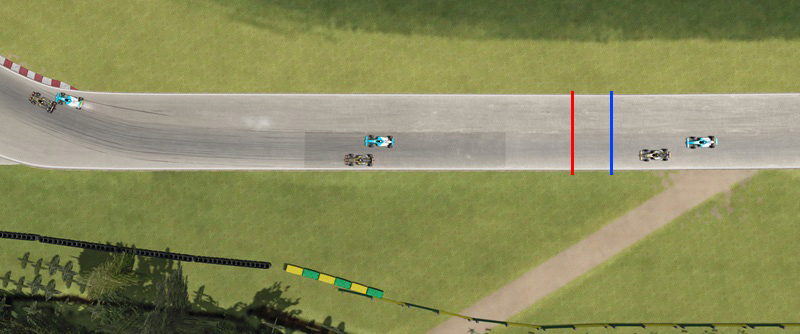
The image shows:
I include the pole braking point to show that I did not brake particularly early at the time of the incident. It’s common to brake earlier during a race than during an all-out qualifying lap.
To be fair to G_Man, this was a corner many drivers handled differently. On his best quali lap, Andris braked even later than the red line, close to that darker patch of concrete. So this is not to say that nobody could brake later than me. But it’s unlikely that G_Man, whose best lap was 2.8 seconds slower than mine, was better at taking that corner.
Even if he was truly faster in the entry, that specific attempt wasn’t well executed. I braked for 1.2 seconds, roughly half of it at maximum pressure. G_Man braked for nearly 1.8 seconds and was still 15 kph faster than me at the point of contact while on a compromised line. Without the collision, he would have gone deep into the corner and may not have made it at all.
More importantly, trying to pass from that far behind at a fast corner is generally a bad decision, such that even if your execution is top shelf, it may still not be good enough. G_Man would have been better off sitting back and waiting for an opportunity at a better overtaking spot, as I did on several occasions while coming up behind slower drivers at this part of the circuit.
This is another reason I had not expected the move. Diving to get momentarily alongside another driver at a corner like Sunny In is always going to get hairy — for everyone involved. I didn’t even consider that he might go for it anyway.
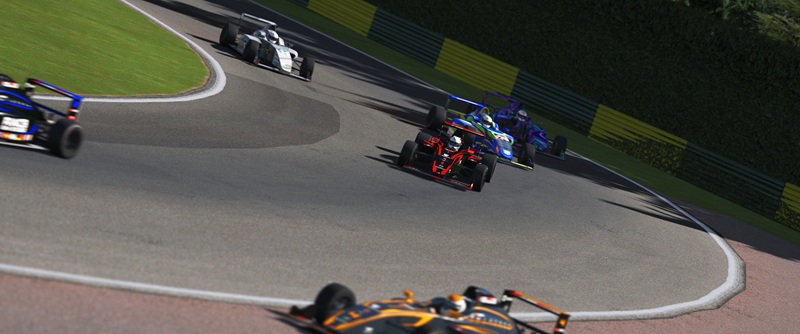
Divebombs are somewhat contentious in real racing. Their fundamental feature is to force a defending driver to take avoiding action, putting them on a suboptimal line and, the hope is, causing them to yield the position.
However, they only work when the defending driver is inclined to yield (occasionally he is not, and the attacking driver is almost always found at fault for the ensuing crash), or when the defending driver has time to yield. Consequently, divebombs are usually reserved for hard braking zones.
Divebombing into a fast corner, where the braking is brief and not particularly heavy, is only asking for trouble.
I began to turn into Sunny In almost exactly halfway through my 1.2-second braking period. Six tenths before, G_Man was still half a car length behind me. By the time I began steering, he had just the slightest overlap with my rear axle. The average human reaction time is about 2-3 tenths, so that’s technically enough time to react — but not much time. Critically, that figure is when expecting to react to something. If you do something totally unexpected and count on someone to react within half a second, you’re going to be disappointed.
So divebombs work when you can depend on defending drivers to respond to them, and that’s outright less likely to be the case in fast corners because of the speeds involved. Putting aside reaction time, fast corners are a bad place for divebombs even when the defending driver sees them coming, because he can simply brake a little deeper and carry more speed around the outside. Had I avoided G_Man, it would have been trivial to stay ahead.
As a result, experienced drivers don’t resort to divebombs in fast corners. They’re simply too likely to lead to a crash and too unlikely to produce an actual overtake. They’re a high-risk low-reward move. This actually creates a feedback loop: Because an overtake is unlikely, defending drivers are less disposed to expect a dive — so if one does occur, they are more likely to be caught off guard. This further amplifies the risk and further disincentivizes the attacking driver to go for it, in turn further leading the defending driver to disregard the possibility.
It’s just a bad idea all around.
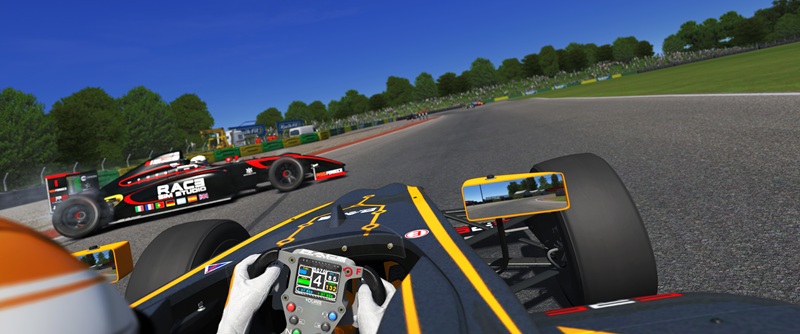
Despite all the reasons I gave for not expecting G_Man to make that move, I should still have anticipated it. I knew the standard of driving on that server was low. Andris and I were a full second clear of the next best in qualifying. There was constant spinning and crashing in both races.
Having reviewed G_Man’s onboards, I can confidently say he didn’t know how to take Sunny In corner at all, let alone with someone near him. This is not meant to disparage him, but to acknowledge that he is inexperienced, or simply lacked practice for this particular event. The point is that I shouldn’t have needed to look at his onboards after the fact to have known to be mindful of him. Knowing that he had started at the front of the reverse grid — ahead of my newbie brother, with all of his 10 hours of total simracing experience — was already one major clue to be careful, among others.
Just as on street roads, the best defense against reckless driving is caution, so one can anticipate the behavior and have more time to respond to it. But defensive driving is slow; in a racing context, it must be done selectively. I failed to identify that it was necessary at that moment and paid the price, even though I’d already seen enough that should have put me on alert.
Every racing situation is unique. There are countless variables to take into consideration, like velocity, tire wear, or the shape of an upcoming corner. Ultimately, I failed to avoid a collision because I didn’t take the time to consider the most important variable: Who am I racing?
I haven’t written a post in a while and that’s because I’ve been busy filling up most of my free time watching the World Cup, playing chess, and mainly getting back into sim racing, which was once a favorite hobby of mine.
Indeed, almost immediately after making a post about recording and uploading my runs of Slay the Spire 2, I busted out my old Logitech G27 steering wheel and forgot all about card games. I don’t doubt that I’ll get back into StS2, but for now, I feel like I’ve fallen in love with an old flame.
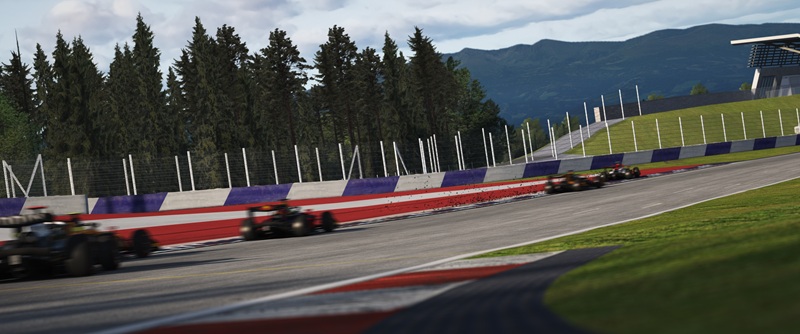
My very first contact with computers and with steering wheels was one and the same, so I’m not surprised to have developed a love for racing video games. I was maybe seven years old. My dad was into racing and had a copy of Rally Championship for MS-DOS.
For whatever reason, he was only ever interested in competing on that game’s shortest stage. One evening, he was particularly proud of a new time he had set and invited me to beat it. I did. He then spent all night working at beating my time, and the next morning I got back on top. This went on for some time.
He was an adult man who drove real cars, competed in karts, and had a fantasy of being a Formula 1 driver. Naturally, he tried to drive the in-game car like a real one, even though all he had in front of him was a plastic steering wheel with no feedback, and probably fewer pixels than you could find on a square inch of your smartphone. I was a child playing a game in whatever way rewarded me the most without any pre-existing habits or expectations. He never stood a chance.
If we had been competing in a modern simulator, it likely would have been a different story. Like other 1996 games, Rally Championship wasn’t very realistic, but it did set me on the path to what would become the niche though increasingly popular gaming genre of sim racing.
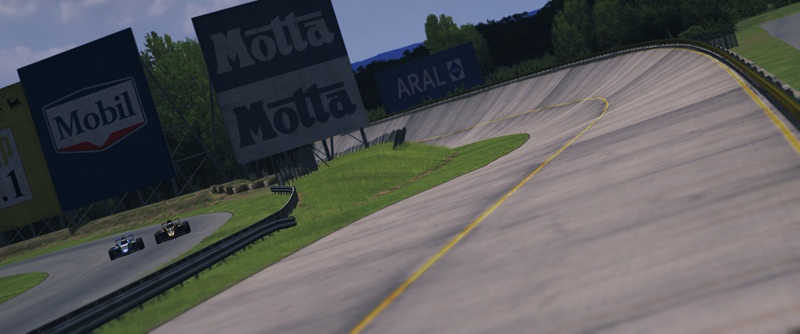
In those early days, I also played Geoff Crammond’s Grand Prix 2 and then Grand Prix 3, the top F1 simulators of their time. Grand Prix 4, released in 2002, was the first video game I purchased with my own money ($20). I was very excited to get my hands on it, with its enhanced graphics and promise of even more realistic handling.
I was immediately dismayed to discover the graphics were perhaps a little too advanced; our shabby home computer could barely run it. I didn’t know much about PC specs at the time and my disappointment was such that I’d have jumped at the occasion if you had told me I could download more RAM.
This, along with our gaming wheel finally breaking — and our dad having long given up on any and all video games and thus having no interest in replacing it — led to an extended break from the hobby. The break lasted until 2013, when I built my first PC. In the excitement of wanting to try new titles to check out the graphics, I picked up Grid 2 by Codemasters.
The game was only fine, but I felt an old love being rekindled and decided to purchase a Logitech Driving Force GT. It was a cheap force-feedback wheel, but compared to the Xbox 360 controller I had been using, the upgrade in immersiveness was intense. There was a short adjustment period during which I was constantly crashing into walls — but even before getting over that, I knew this would forever be the way I wanted to play racing games.
Soon after, a renewed interest in Formula 1 led me to F1 2012 and then F1 2013, as well as to organized competitions. I joined a league and before long was racing near the front of the grid.
At the end of 2013, I had my first taste of a proper modern simulator with Assetto Corsa. I still remember my first time driving around Imola in a Pagani Zonda R. I had never had so much fun in a racing game. The liveliness of the handling, dancing on the edge of grip, the sound of the car, the laser-scanned detail of the track. I was totally, utterly hooked.

Over the following two years, I upgraded to a triple-monitor setup and Logitech G27 steering wheel. I competed in the Assetto Corsa Racing League and did very well, winning three championships. In 2016, I tried virtual reality for the first time and never looked back. In my mind, its level of immersiveness is worth any downside. It is the way to play racing simulators.
But starting in 2018, my interest began to dwindle. It was just too inconvenient to constantly get set up. My desk was simultaneously my work place, gaming zone, and sim rig. If the G27 was in place, it got in the way of everything. If I set it aside, it took time to set it back up. Eventually, the friction added up.
I dreamed of a separate, dedicated sim rig with a better set of wheel and pedals, but the price was incredibly prohibitive. I modded my brake pedal for a minor cost, which helped with consistency; further expenses I couldn’t justify. Then, after getting divorced and moving to a new state, the G27 essentially never left its box, and my interests expanded in other directions.
Until last month. I had an itch. It had been building for some time, and finally became strong enough to get set up again. And wow, it has been so fun. I had really missed racing. I joined several Discord groups to find Assetto Corsa races and found that if I wanted, I could participate in organized, high-quality races several times per week. And unlike my former self, I am not so obsessed with winning (or rather, not losing) to the extent of feeling compelled to practice endlessly, which definitely helps to keep things fun.
But there was still the issue of setting up. The G27 still got in the way of other PC activities, and getting it in and out of place was the same old hassle. Also, after being wrangled for over 1, 000 hours, one of the clamps was damaged, so the wheel was liable to slip off the desk if I pulled on it a little too hard. The whole setup was just flimsy. My chair could roll back when I pressed on the brake pedal. I was constantly having to mind these things when racing.
So finally, I decided I was done waiting for that once-forgotten and long-postponed dream of a dedicated sim rig. I found some good deals, decided I would be OK with the headache of setting everything up and having even more work to do when I move in a year or two, and spent a lot of money. Still less than on a compact Eurorack system, mind you. Synthesizers sure have a way of making other hobbies look affordable.
Setting up actually took less time than I expected. And I’m having so much fun. The level of immersion is on another level and the whole thing is now properly rigid, so I can finally turn off that part of my brain that used to worry about rolling back or pulling the H-shifter off the desk.
So anyway, I wanted to share. This has been at least 12 years in the making. I could even say 28 years!
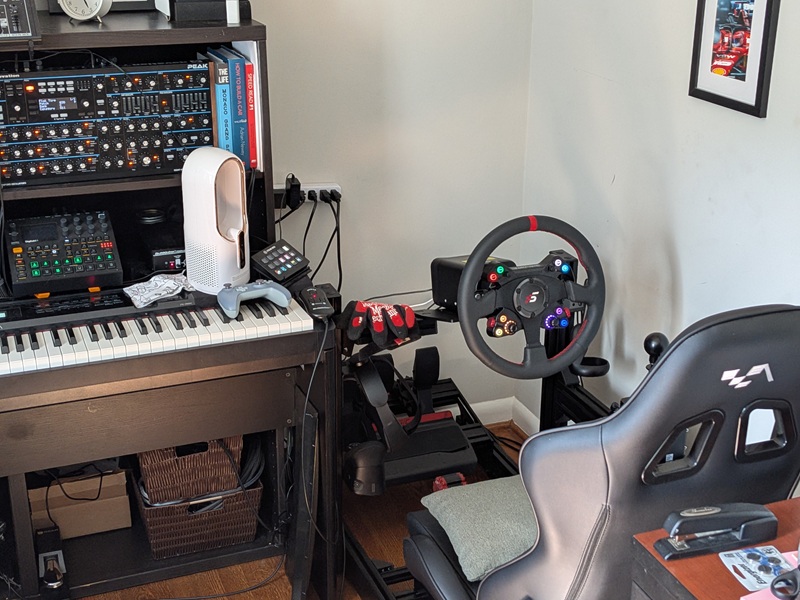
Another perk of VR … you can tuck the sim rig anywhere and not have to worry about screens! I’ll have to add some decoration to those walls, though. They’re looking pretty bare.
I really like the game Slay the Spire. Between Steam and mobile platforms, I guess I have sunk some 600-800 hours into the first game, and I’m already up to 200 in the sequel, which came out at the start of March.
That’s nowhere near the playtime of the top players. The game has a large audience of casual strategy gamers who enjoy assembling overpowered combos, as well as a niche of hardcore players who enjoy min-maxing and thinking through every move as thoroughly as possible. For them, the challenge is core to the reward of playing the game. Therefore, it’s important that it remain genuinely challenging — and at least in the first game, that challenge was stimulating enough to entice some to keep at it for many thousands of hours.
I’m far from the best player, but I’m pretty good. I defeated the Heart on Ascension 20 at least 40 times in the first game, something only about 5% of players have done once; and earned every achievement, which is even rarer. I was able to apply my game knowledge to the sequel and raced to Ascension 10, the currently highest difficulty level, with a winrate around 90%.
There are levels to this game, though. While I’m probably among the top 5% of players, the very best players have more consecutive wins with each Slay the Spire character than I have wins on those characters in total. And while I don’t intend to put in the 10,000 hours of playtime that some of those players have done to reach that level, I do want to get better.
Part of that project has been to record and upload all of my runs on YouTube. It’s not so that I can review and assess what I could have done differently — though that’s part of it — but primarily so that I force myself not to save-scum.
Save-scumming is the practice of saving and leaving a game of Slay the Spire in the middle of a fight, then resuming the game. This puts you back at the start of the fight — and because the order of cards in your deck, enemy actions, and various other things are predetermined by the seed, it’s easy to predict what will happen and hone your strategy if needed.
This can help you avoid death or, when used liberally, help you optimize every fight in order to make you stronger throughout the whole run. It’s very powerful and makes the game much easier.
To some, it is just a part of the game. After all, if the developers didn’t want players to do it, why would they leave it in? But most players, including me, agree that save-scumming disqualifies runs from being included in world record streaks and the like. They don’t really count. And for players who enjoy the challenge, save-scumming is self-defeating.
Certainly, it’s a great way to avoid getting better at the game. It serves as a crutch that prevents players from actually getting better, because it gives them more room to play poorly and get away with it. I don’t remember when I started save-scumming, but recently I felt I had gotten too comfortable with it and decided I wanted to stop. I figured having a mechanism to enforce it would be helpful.
So now I am uploading my runs on YouTube. There’s not a lot of effort that goes into them. I press record and play; and if I win, I cut, render, and upload. So far, I have uploaded 6 wins (out of 18 games). This is about half of my winrate prior to committing myself to never save-scum, which is a bigger drop than I expected and shows that even doing it sparsely can have a major impact on the challenge.
Still, winning 1 in every 3 games at the top difficulty is not bad and I already feel like I’m a better player. But when players like Xecnar believe every run is winnable, it feels far from what it could be. Could I get to winning 1 in every 2, to start? I plan to try.
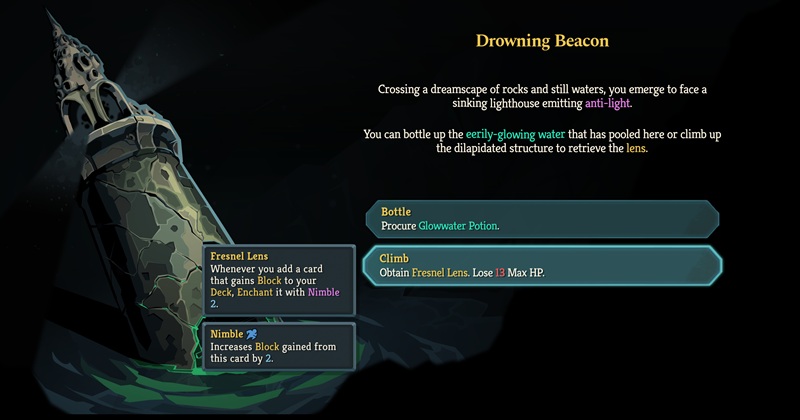
In Slay the Spire 2, an Act 1 event called “Drowning Beacon” offers a choice between two rewards:
Fresnel Lens is a relic that causes every future card that gains block to automatically gain the “Nimble” enchantment when you add it to your deck, giving that card an extra two block over the base amount.
I’m writing this post because many Slay the Spire 2 players on Reddit seem to believe the cost of choosing Fresnel Lens — losing 13 Max HP — is sufficiently negligible to make the decision a no-brainer. It’s obvious, they say, that the extra block from future card rewards will save you far more than 13 HP.
Losing Max HP, though, can represent a much bigger effective loss of HP throughout a run of Slay the Spire. Ancients heal for 80% of your missing HP at the start of Acts 2 and 3, so taking the Lens means losing out on 10 healing twice. Additionally, you can heal for 30% of your Max HP by resting at campfires. If you picked Fresnel Lens, you will heal for 4 less each time.
Also relevant are Blood Potions and several events that heal based on Max HP (I’m aware of at least three). But for simplicity, I will disregard those.
So how much effective HP can you reasonably expect to lose? At minimum, 20. Then we need to guess how many campfires you may visit afterward.
Across my 70 wins in StS2, I have visited an average of 8.8 campfires — almost three per act. For Ascension 10 wins, the average goes up to 9.0. It’s possible that by the time the Drowning Beacon event appears, you will have already passed 1-2. Expecting to stop at anywhere from 5-8 more afterward is realistic.
Looking at A10 alone, I chose to rest 67 times at 149 campfires across 16 wins. In only three runs did I rest fewer than three times. Notably, wins overrepresent runs with less resting, as stronger decks are less likely to take damage.
With that in mind, a conservative guess is that you will rest at least three times after encountering the Drowning Beacon event. It’s just as likely that you might rest twice as much as that. But sticking with the conservative figure, this represents a lost opportunity to heal for 12 HP, if you chose Fresnel Lens. Factoring in the Ancients brings that up to a potential loss of 32 HP — not including any additional rests, or healing potions and events.
But hang on — doesn’t Fresnel Lens solve your block? Won’t it help you take less damage and thus require fewer rests at campfires? Won’t it help you path more aggressively and snowball the run? This is what redditors argue, and it’s wrong.
To determine whether Fresnel Lens can help you make up for the loss of effective HP, you must ask the following question:
How much damage must you block until the extra block on the enchanted cards has compensated you for the effective HP loss?
Due to the high variance across Slay the Spire runs, it’s impossible to make exact estimations. A plausible scenario is ending the run with about half of your block-generating cards being enchanted. For example, you might have 5 Defends, 2 block cards picked up before Fresnel Lens, and 7 cards picked up after.
Let’s say the average amount of block generated by those cards is 8. Most block cards in the game don’t actually block for very much, but Fresnel Lens is bringing up the average. This would mean Fresnel Lens is responsible for 1/8th of the total block generated by the deck and that, on average, you would need to block 256 total damage before the enchantment made up 32 of it.
Even if that 50:50 ratio of enchanted:unenchanted cards isn’t accurate, it’s notable that this is only by the end of the run. On average, you will spend most of the run with fewer enchanted cards than not. Consequently, you will have blocked far more than 256 damage before Fresnel Lens contributed 32.
All of a sudden, the tradeoff is nowhere near as straightforward as redditors suggest. You can definitely expect to block some 256 damage in runs of Slay the Spire 2, though many of the game’s defensive options have nothing to do with block-generating cards. I realize this is a lot of napkin math, but the core idea remains true: That you must play many Nimble-enchanted cards before Fresnel Lens pays itself off.
More importantly, determining the value of Fresnel Lens is not about whether you’ll play the enchanted cards enough times to block some 32 damage — it’s about how long it takes to get there.
Fresnel Lens does pay off eventually, but the timing of that payoff is unpredictable and slow. To use enchanted cards, you need to actually put them in your deck. That means choosing block-generating cards over other cards. You may not always want to do that, especially in Act 1, where it’s often more important to focus on damage. It’s possible that the block cards offered to you are still bad even with the enchantment. It’s possible that they don’t appear at all.
If you choose Fresnel Lens, it’s plausible to start Act 2 with a deficit of 14 HP and virtually nothing to show for it. You may have 0-2 enchanted cards in your deck. In hallway fights, it’s common to cycle through your deck only once. If you happen to draw an enchanted block card on the right turn and fully absorb damage with it, you can count yourself fortunate that you have now compensated for 2 of your 14 missing HP.
By the time you reach the first Act 2 campfire, you will most likely have less HP than if you hadn’t picked Fresnel Lens, and consequently be more likely to have to rest and thus have another 4 HP to make up. You may get around to breaking even by the end of the Act, only to then be set back another 10 HP at the start of the next one.
If you can make it that far and find good block cards along the way, then Fresnel Lens undoubtedly begins to work in your favor. But that’s if you make it that far.
Contrary to the idea that it solves your block and thus enables you to play more aggressively, Fresnel Lens sets you back on the power curve, then challenges you to compensate it for it as the run goes on. It is a relic that aims to give you long-term survivability scaling at the cost of short- and medium-term survivability scaling. It doesn’t make sense to evaluate it as though it provides the sort of short-term strength necessary to avoid resting at campfires and snowball a run.
Another downside of Fresnel Lens is that it automatically makes every future block card you choose ineligible for any other enchantments, including non-Skill cards that happen to have some block attached to them.
Losing Max HP also puts you at a greater risk to variance in incoming damage, especially earlier in the run when you won’t have had the time to pick up enchanted block cards to mitigate that variance.
Fresnel Lens costs you even more effective HP whenever it would cause you to overheal. It’s not uncommon to rest at the final campfire before the Act 3 boss gauntlet even if above 70% HP. For example, if you rested from 48/60 HP, you would start the fight at 60 HP — as opposed to 70 if you had rested from 48/73 HP. In this single situation, the lower Max HP is costing you 10 effective HP in the next fight. You would need to successfully block — and not over-block — with at least five enchanted cards to break even.
Additionally, this whole time I have only compared choosing Fresnel Lens to simply playing the game without it. But the actual choice is between Fresnel Lens and Glowwater Potion, a genuinely good potion that actually provides the short-term power that can help you play more aggressively.
It feels hard to get anything done. Not because it isn’t possible, but because so many things feel worth doing that doing anything feels like missing out on something important.
Off the top of my head, I can list at least two dozen things I’d like to do regularly and in the short term; goals, habits, and relationships I want to invest in. But doing almost any of them well requires giving up on a significant number of the others, and even just doing a few of them medium-well still uses up all the time there is, and that’s without factoring in the non-negotiables like work, chores, feeding myself, and so on.
Clearly, there’s no getting around the fact that there is an enormous amount of choice in the world. We can be anything and do anything. How do we feel good investing in one thing, knowing it means giving up on another?
This is why I’ve long felt affection for the famous Robert Frost poem, “The Road Not Taken.” It’s a pet peeve of mine that most people only know the poem for its last three lines, which they misquote as an example of inspiring individualism. This misses the whole point. It’s a poem about how life presents us with diverging paths, and as much as we’d like to explore both, we can only choose one, knowing we’ll never be back to see the other.
If only it were as simple as two paths. Life, of course, presents us with infinite paths. I want to be a jazz pianist, an author, an international traveler, a humanitarian worker, a lover, a husband, a father, a friend to many, a pro athlete, a pro gamer, a pro driver, a politician, a live dance musician, a journalist, a baker, a business owner, a mechanic, a technician, a carpenter, a pilot, mountain biker, base jumper, skydiver, deep sea diver, philanthropist, polyglot, and so many other things. I haven’t even tried to be many of these, yet I’m already overwhelmed by the few paths I have explored.
I don’t want to dabble in a million hobbies, playing the part of the good consumer who spends his money on many different things because he cannot commit to any of them. But how can I feel good about giving up on so much? I certainly can’t delude myself into believing that I took the path less traveled by, which is, in fact, the sad ending of the poem.
After going at length to tell us that both paths were “worn […] really about the same,” the author hesitates and admits that in the future, he will lie: He will say he took the one less traveled, and that this is what made the difference. It’s a comforting fiction to make him feel better about the path he wasn’t able to take, a way to get out of the indecision.
Then again, any path we choose is automatically less traveled, because everyone’s path is his own and therefore unique. I suppose there can be some comfort in that.
I am not ready
To love and hold you only
In old memories
-—
Loss is so wretched
It seems a wonder we can
Still love after it
-—
If it seems silly
To grieve a cat so — just know
He let me love him
-—
His eyes were yellow
Carved from a sun still youthful
They shall see no more
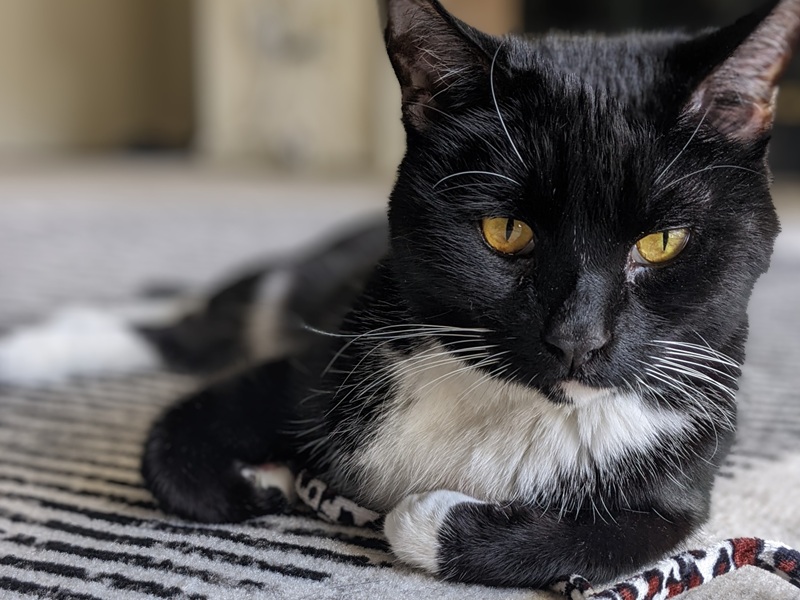
A long time ago, I thought I did not care for cats — or for pets of any kind. As soon as I opened my heart to the possibility that I was wrong, you came into my life and began to show me just how much it was possible to care after all.
This is a gift beyond words. Thank you, and goodbye, my sweet boy.
It’s been almost a month since launch and the site has already grown a lot. I feel happy with the state of its appearance and functionality earlier than expected, though admittedly I spent a lot of time making it happen.
There’s still plenty to do, but it’s increasingly feeling like I’ve got most of the building blocks I need to start shifting from functionality to content.
ChatGPT has been equal parts frustrating and helpful in getting things done. Prior to starting this project, my familiarity with HTML, CSS, and JavaScript was around 3, 1, and 0 out of 10, respectively. Being able to use ChatGPT like an interactive search engine has been very useful for solving small syntactical issues, feeling out how I might implement an idea, and providing basic JS scripts. Sorry, StackOverflow — it’s not looking good for your future.
But interacting with the LLM has also been an exercise in patience. It so often and so confidently spits out wrong solutions and inconsistent code. It has a tendency to arbitrarily rename variables and even when you ask it to be concise, it loves to say more than necessary, repeat itself, and end every chat with a prompt. Gotta keep the end-user on the platform.
There’s a lot of time that goes into dissecting its answers and clarifying communication. And personally, I’m not interested in merely copy/pasting code without understanding what it is doing. When I do end up on StackOverflow, W3Schools, or reading documentation, I tend to learn more and get better results. But even accounting for the friction involved in using ChatGPT, it still saves time compared to using Google. Search engines have gotten so bad.
Probably the main reason AI has been helpful is that it integrates well with the typical learn-as-you-go coding workflow. I wasn’t very familiar with web-focused languages, but I did take Java courses in college and taught myself Python. I have a decent sense of how programming languages work even if I don’t know all the syntax, and AI is pretty good at teaching that.
I doubt it would be as useful if I had greater mastery over the specific languages I need. I’ve tried using ChatGPT for assisting me in writing, for example, but I’m a professional writer with years of education and experience. I always conclude I could write something better in less time than it takes to painstakingly craft hyper-tailored writing prompts. It’s just not that good.
As with coding, LLMs are better used as a search engine you can talk to — though as we all know by now, one must beware their fondness for inventing facts.
Fundamentally, programming languages are tools used to build scripts or programs that serve some function. The critical part is that you don’t need to learn everything; only the narrow set of things relevant to solving the next problem. (That’s really the case for all learning, but let’s not get carried away.)
Coding lends itself well to that one-problem-at-a-time approach because it’s very modular. When you learn a new trick, it becomes eligible for reuse elsewhere — sometimes very obviously so. As soon as you identify repetition in your workflow, there’s probably a way to automate it via some function.
When I work on a programming project, it is always an exercise in optimizing that modularity. Building a website from scratch has been like building a house, its foundation, and the tools and materials all at the same time.
Even though it seems inefficient, it is simply unavoidable in my mind. To avoid it — sticking to the house analogy — one would need:
That may be feasible with a project manager and a competent team, but I’m just one guy with limited web coding experience. This is why I was quite set on a launch-it-first-and-worry-about-the-rest-later approach.
I think it has worked out.
There are still many things I want to work on, like:
And also the following:
The basic HTML <audio> element is very limited and simply not good enough for my needs,
considering half of my website is dedicated to sharing music. My friend over at
enoodle.net uses Faircamp for the
album side of his site. This seems like it could be a good solution if I had only music on my
music subdomain, but I don’t — and I think I’ve decided that I won’t.
Besides, I’d like to challenge myself to create an audio player of my own. I’m hoping it will be good opportunity to properly sink my teeth into JavaScript, which hasn’t really been needed so far.
I’m currently running this server on a disused laptop I bought in 2015. This was a great way to dip my toes into launching a website without any upfront cost. But it has a slow processor, slow hard drive, and consequently the connection to the website often times out (though I haven’t entirely ruled out other causes for that).
For the time being, traffic is light. But as I plan to increase my exposure and continue adding a lot of media files to the site, the laptop will not be suitable in the long term and I will need to look for a better alternative.
Above the dry leaves of a late winter
A butterfly dances upon my breath
It would have been a pretty afternoon
In this waking forest so close to bloom
Without turning back to the cold and dark
To find some farewell in my aching heart

It has been a tough month. On January 22, I took my cat Data to the vet after noticing he had lost weight, his coat was getting ragged, and he seemed to have difficulty eating.
My initial concern was dental, but his teeth were fine. He was instead diagnosed with hyperthyroidism and started treatment. He got worse almost immediately and a possible gastrointestinal issue was suspected. Eventually, we discovered a mass in his inner ear. But by then it was too late. It had already caused nerve damage.
Data is now blind in his right eye and has little control over his tongue, so he cannot eat properly despite having an appetite. He’s frail and bony, weighing only 7.5 lb — down from a normal 11 lb. I remember when he used to be over 13 lb and I wanted him to lose weight. I would be beyond thrilled if he could be that chunky again.
Data is only 12.5 years old, which is senior but still somewhat young to be passing away (in human years, it’s equivalent to about 66). But I have seen the age creep into his face, and I have dreaded his death. Almost exactly 1 year ago, I had a huge crying fit about losing him and my other cat, Merlin.
I knew it would hurt badly when the moment came, yet despite this, I have been utterly hammered and staggered by the emotion. It is even worse than I imagined. Somehow, I love him even more than I realized, and I knew I loved him tremendously. It feels unreal.

Four years ago, my ex-wife cheated on me and left me over the phone. I sold the house I thought I would live in for the next 30 years. Her friends, who after years of hesitation I had finally begun to accept as my own friends, treated me badly. I had to say goodbye to our dog Millie, who I had proudly trained, named, and loved with all my heart. I moved out of state. We fought over what little money I had for almost a year.
I mention all this because it was, in short, a very difficult time. And yet, the prospect of losing Data feels sadder than the divorce ever did.
He was my first pet, rescued from the side of a highway when he was a kitten barely bigger than my hand. I got him a few months after my parents’ own separation and I stopped talking to my dad. Consequently, even though I was 22 at the time, it feels like Data has been with me my whole adult life.
Over the past 12 years, he has moved with me six times, and has been the most constant thing in my day-to-day. He lets me cradle him, he climbs on my shoulder, and every evening when I go to bed, he sits on my chest to give me head boops. He shows an enormous amount of affection and trust toward me. I feel so privileged for that.
Even now, he still climbs on my shoulder, and lets me nuzzle him with my head. Thanks to steroids and painkillers, he has just enough energy for it. Yet tomorrow morning, he will be gone.
One key part of this whole experience is guilt, but not the kind you might think. There is, of course, remorse over all the things I could have done differently that may have averted this situation. But the greater guilt is over a failure of empathy.
I know people who have experienced losses at least equivalent to my own, or even greater. Yet I did not feel for them the sorrow that I feel now for Data and for myself, and frankly would have struggled to imagine it in them. I think that is probably normal, but it still fills me with a sense of shock, regret, and shame that it seems so difficult to truly and intimately connect with others without having first lived through similar experiences.
If the loss of a cat can make me feel like this, I cannot even begin to grasp the vastness of the suffering that must fill the world. It is crushing. Whoever you may be who has gone through this, I am so sorry.
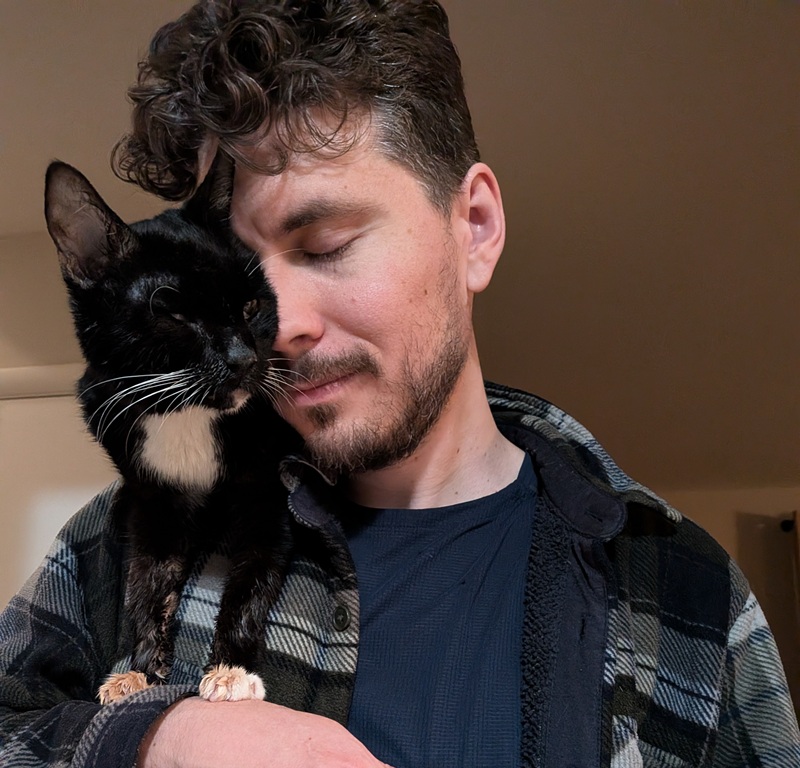
We’re live! I don’t have much time right now because I need to think of some place to take my beautiful girlfriend out on a date tonight, and she deserves some effort from me. So I’ll keep it quick:
Predictably, things have already changed. I gave up on LibDocs and other CSS templates after deciding that (1) The layout of LibDocs didn’t actually suit my site, and (2) It was far too tedious to reverse-engineer what the CSS was doing when the scope of my site is not complex enough to justify it.
Instead, I’m writing my own CSS, which is far simpler and thus more conducive to understanding what it is I’m actually doing and how I can alter it to accommodate my needs. Also, it’s more fun.
I’m at the point where I have a rudimentary site ready to go with some content, which means the next step is to go live, which means buying a domain. I’m running into a hiccup here, because I’m no longer settled on klovysmusic.com. The focus isn’t just music, so that would be confusing or even misleading to anyone being linked to this site because, say, I wanted to share my review of the Sirens miniseries.
Additionally, even if musicandmusings.com or musingsandmusic.com weren’t both taken, I think I prefer having my name in the domain — but klovysmusingsandmusic.com seems too long and complicated, klovysmusingsmusic.com looks like a scramble of unrelated words, and besides, I’d like to be nice to the dyslexic if I can help it. I vaguely considered klovysmm.com but I don’t think that makes any sense and would, if anything, make people think I was selling candy.
So I’m left with the obvious: klovys.net (.com is unfortunately taken). Thing is, I do prefer the feel of something like klovysmusic.com. There’s purpose in a name like that. You know what you’re going to get before the page even loads. I want that.
So I think I’m leaning toward using subdomains. One would be music.klovys.net and the other musings.klovys.net. I’d prefer .com but I suppose I should accept that just won’t happen. In theory, that looks good to me. In practice, I don’t know anything about subdomains except that I am probably adding more complexity to this whole endeavor.
Maybe it’s not that bad. I don’t know yet. That’s the nature of not knowing anything. I’ll figure it out tomorrow!
Two lights fade this night
Only one seeks the morning
Without grief or fight
-—
Her hips sway like grass
In a gentle evening wind
Lazy, hypnotic
-—
I could dance on the
Curve of her lips, beneath eyes
Like butterfly wings
-—
Sleep, please wait a while.
I wish to dream of my love
With my waking mind
-—
Show me how to love
Like I never have before,
Then ask me for more
It is likely that I am writing this long before it will actually be available to read on the web. However, by the time it goes online, it will have been published alongside several backdated articles imported from other website I’ve used to blog over the years. And so, despite technically being my first post written for the site, it will be thrown into a stew of various other posts that will make it appear as though the site has been cooking for some time!
How long it will take to get it online, I do not know. I need to learn HTML, Markdown, and CSS before I can build a website I can pass off as my own. Fortunately, there are many easy-to-use tools all over the internet and I already have some familiarity with some of the necessary skills.
I’m also determined to get the ball rolling before I’m actually satisfied with a final product. If I decide I cannot launch the website until it is to my satisfaction, then it will never be launched. As soon as I have a working template that doesn’t look very obviously ripped straight from Eleventy LibDoc — which is what I did — then I will immediately move on to the next step, which is to get a machine running the site 24/7.
That means starting with CSS and server hosting. I’m hoping to use the klovysmusic.com domain, which would lead visitors to my discography and blog. The site would be called Music & Musings and clicking on the blog would lead to the klovysmusic.com/musings domain. Fingers crossed that whenever you happen to read this, those links are live! Or not. Who knows, I might think of something better.
That future can wait for sensible layouts, navigation, tags, and the million styling tweaks I will undoubtedly make. After all, whatever state the website will be in when it launches, it will not be its final form. So what does it matter if that temporary form is great, good, or even barely passable? As long as it has form, that will be something.
And it’s not like anyone is reading anyway!

I discovered modular synthesizers roughly four years ago, and knew at once that I wanted one.
Unfortunately, as is known by all who have felt lure of modular, the cost is prohibitive. Even a small skiff realistically costs over $2,000 while still being quite limited in its capabilities.
If you want a more complete modular instrument, such as by filling a 7U 104HP case, then the cost can easily exceed $6,000. And while this is a common size for fully-fledged, self-contained modular setups, it’s also firmly in the low/mid-budget range for this hobby. If you can afford it, the sky is the limit — or rather, the ceiling of your studio space.
Not included is the cost of patch cables. Even cheap ones cost about $2.50 each. The useful stackable ones start at $6. Anything beyond a small rig is likely to require several dozen, meaning that if you’re going to get into modular, you should probably expect your patch cable budget to start in the three figures.
Then again, once you’ve spent several grand on a fancy system, what’s another $150 on the cables that will actually let you use it?

When I first began to dream about modular, $150 did matter. I was in the middle of a divorce whose strain on my finances ensured I couldn’t treat even the smallest expense as an afterthought. Consequently, modular synths were part of a fantasy I prescribed to the future. Even if I had wanted to get into it piecemeal — buying a module here, a module there — I simply couldn’t bear the startup cost. A case, a power supply, and a single nice module could still run anywhere from $500-$1,000.
Not only was this more than I could afford, it was hard to imagine a worse value proposition. Modular is exponential. Every new module adds value to the ones you already have, but it takes a good handful to get anything remotely as capable as a traditional synth. Without prior gear or the ability to buy a decently-sized system all at once, it simply makes no sense as a starting point for making music.
And indeed, if the goal is to produce music, modular can be difficult to justify. I’ll get into that in another post, but for the moment, it’s enough to say there are many pros and cons to consider, which I didn’t have to do because the cost alone was enough to outweigh all other factors. So I waited, budgeted, and made music. From spring 2022 to fall 2023, I worked purely “in the box,” spending money only on an FL Studio license, a pair of speakers, and a small MIDI keyboard. I was lucky enough to already have a digital piano and a good pair of headphones.
Eventually, I purchased my first hardware synthesizer. This was shortly before publishing my debut album, Space Bunny, as a reward to myself for taking the hobby seriously and for nearly two years of meticulous budgeting. It wasn’t modular — that was still too expensive — but with the goal of one day getting around to that, it was semi-modular. I had chosen an Arturia MiniBrute 2S, used — $365 after taxes and shipping, down from a retail price of $500. Not bad.
That was over two years ago. Since then, my budget has grown and my hardware expenses ramped up to match. First, I spent six months jamming my heart out on the MiniBrute, learning its ins and outs. I discovered I preferred using it for making bass lines, and feeling badly that it needed a drum machine companion, I paired it with a Roland TR-6S. I chose it for its affordability, portability, and appealing library of classic sounds — though I quickly decided I did not like the workflow.

Four months later, I bought a Novation Peak to serve as my polyphonic synth workhorse, as well as a distortion pedal through which to route the MiniBrute. After another four months, I decided I needed sequencing and sampling capabilities, knocked out those two birds with one Elektron Digitakt II, realized it could also be a drum machine, and sold the TR-6S.
I bought all of these devices on the second-hand market and saved good money doing so, but the cost of related equipment added up — especially as I felt a rising desire to disconnect my music hobby from the computer that already took up so much of my time. As of selling the TR-6S, I had also acquired a MIDI controller, MIDI merger, MIDI splitter, audio interface, audio mixer, USB hub, speakers, stands, and a veritable menagerie of cables and adapters.
Thanks to my meticulous bookkeeping, I knew that my whole music studio had cost $3,650. The instrument themselves made up about $2,450, and the remaining $1,200 had been devoted to equipment that existed purely to support those instruments. Keep that in mind if you ever decide to go DAWless. It’s a reality of this hobby.

I felt happy with my three hardware devices (four, including the piano), but I still had my mind on modular. Specifically, for almost as long as I had known modular existed, I had kept an eye on the Tape & Microsound Music Machine by Make Noise. Every module in the TMMM seemed inspiring on an individual level as well as in the context of the whole system. True, the idea of buying or assembling a predetermined system seemed to go somewhat against the modular ethos — but I couldn’t shake the appeal of the TMMM.
This was doubly true because over time, I had gravitated toward wanting modules for FX processing, and wished for my modular system to have very little overlap with the rest of my hardware in terms of functionality. The TMMM seemed to fit while still having the ability to be played by itself if desired.
Finally, in August 2025, after endless planning, budgeting, and second-guessing, I decided I would no longer wait. I purchased a powered case, an input/output module, an oscilloscope, and a Mimeophon. Along with cables, this cost a little over $1,100.
I decided that after this, rain or shine, I would spend roughly $500/month until I filled the case. This would give me room to learn modules one at a time without getting overwhelmed, but still be fast enough to complete the system by early 2026. My finances were finally more than healthy enough to support this, and after putting off modular for 3.5 years, I decided I would not allow myself to hesitate any further.

As of writing this, I have now acquired all of the modules in the Tape & Microsound Music Machine — except two minor ones that I will not be getting. I’m left with some small gaps, which I’ve yet to fully decide how to fill. But after getting my last major piece of the TMMM, I wanted to reflect on how far I’d come.
Next week, my marriage will have ended four years ago. In the year that followed it, my finances were in freefall. Not long before the separation, my ex and I had bought a house into which I’d put a lot of my own money to purchase and renovate, as I had anticipated to be there for a long time. Consequently, when we sold the house just a few months later, it was at a loss to me even though the value had gone up — and a gain to her. This was exacerbated by her refusal to pay for any lingering joint bills, like foundation repairs for the house that the buyers requested after an inspection.
I didn’t help my situation by moving out of state to a city where the cost of living was higher — though at the time, we had agreed on a marriage dissolution. It wasn’t long before I received divorce papers in the mail, containing a list of laughably exaggerated grievances and several flat-out lies. This didn’t stop a judge from ordering me to pay $500/month in spousal support because my ex was unemployed. She had, just before the separation, quit a full-time job that paid $2,000/month (net). My own income was $2,700/month. It doesn’t take a math savant to see this doesn’t add up.
I didn’t push back against the spousal support because my attorney had told me it would be refunded to me in the final settlement. In fact, it wasn’t. It only served to put pressure on me to complete the divorce proceedings as quickly as possible — to agree to unfavorable terms to stem the bleeding. Then there were the attorney fees, and the disbursement my ex received from my retirement account. I was entitled to half her marital savings as well, of course — she just didn’t have any. Her money had been for spending. I was the piggy bank. All the budgeting in the world won’t matter if you marry the wrong person.
Back to the present, I find a kind of poetry in that $500/month figure I allowed myself to spend on modular. Three and a half years ago, this was money that put a genuine strain on my finances. In truth, it doesn’t even come close to representing the full cost of that divorce … but I like the symbolism. It took until mid-2024 for my finances to fully recover, yet I am now thriving and able to spend more on myself than ever before — and for the first time in my life, I am also allowing myself to do so without constant second-guessing.
So far, the modular system has been a lot of fun and has so much to offer. I’m not entirely convinced I will keep all of the TMMM modules, but I am settled on limiting the system to my current case at least until I move again, which I’m not in a rush to do. After expanding my hardware setup for the past two years, my goal is to slow the expansion and focus on refinement, and on actually uploading music. I play all the time, but I’d love to have something to share to the family members that ask.
Happy New Year <3

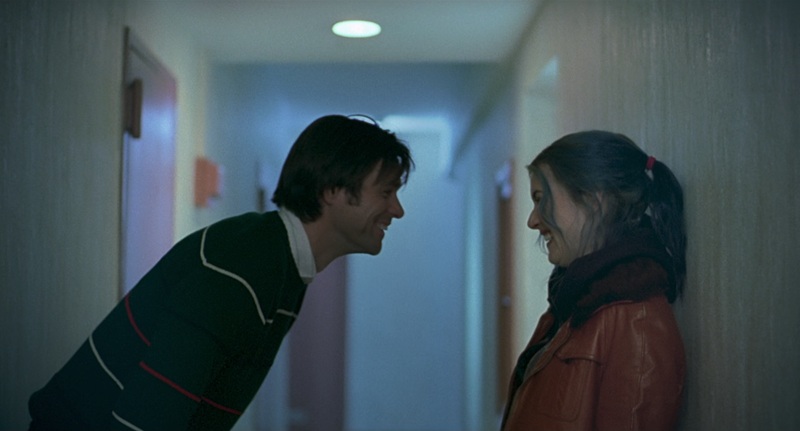
This review contains spoilers.
I was upset when Eternal Sunshine of the Spotless Mind’s final chapter unraveled — as Joel went through the motions of the movie’s opening scene, and met with Clementine in Montauk and rekindled their relationship. The movie presents this as a sweet love story, a romantic reunion produced by Joel’s sheer subconscious love of his ex-girlfriend; but I hated that he was rushing back to a person who had chosen to erase all memory of him without even the dignity of breaking up with him first. This is a cruel and abusive act (even if the victim likes your impulsiveness), like the worst possible version of ghosting a long-term partner without warning.
The movie redeemed itself when it showed Joel and Clementine confronting their former qualms about each other. There is wisdom in their choice (at Joel’s urging) to try again anyway. It is not unlike what many already do when starting a relationship, even without the benefit of knowing how it will turn out. As Clementine says, getting bored with people is what she does. She doesn’t need a recording of herself to guess where any relationship she has might head. And as experienced people (should) know, the honeymoon phase doesn’t last forever.
All relationships eventually face challenges, uncertainty, the risk of stagnation. When Joel is undeterred by what the future seems to hold, he represents every person who has ever thrown themselves at a relationship for the sheer love of the experience itself, despite knowing it might not last.
Most things don’t. But they’re still worth having.
Tried just three games this time, but they were all pretty fun.
Escape room puzzle game
Escape Simulator 2 is the type of game best suited to those late evenings when you still want to do something while hanging out with your friends, but no longer have the energy for a high-pressure competitive multiplayer experience. A friend and I downloaded it on a whim when searching for co-op puzzle games and had a good time escaping the lone available room. It wasn’t too challenging but it was fun and kept us busy. It did share a weakness with real-life escape rooms, though: while the idea is to collaborate, it’s often easier to solve puzzles by yourself.

Cozy city builder
Town to City is yet another cozy city builder that doesn’t take any risks. It might not have to. The point of these games is to relax, make various unimportant decisions, and build a pretty town. If they ought to be anything, it is to look good and give players the tools to realize their vision. In Town to City, for example, there are no penalties for moving buildings or roads. Unlike a Cities: Skyline, it’s not challenging your ability to plan a city — it’s merely helping you build one. And I think we can all agree it’s very pretty.
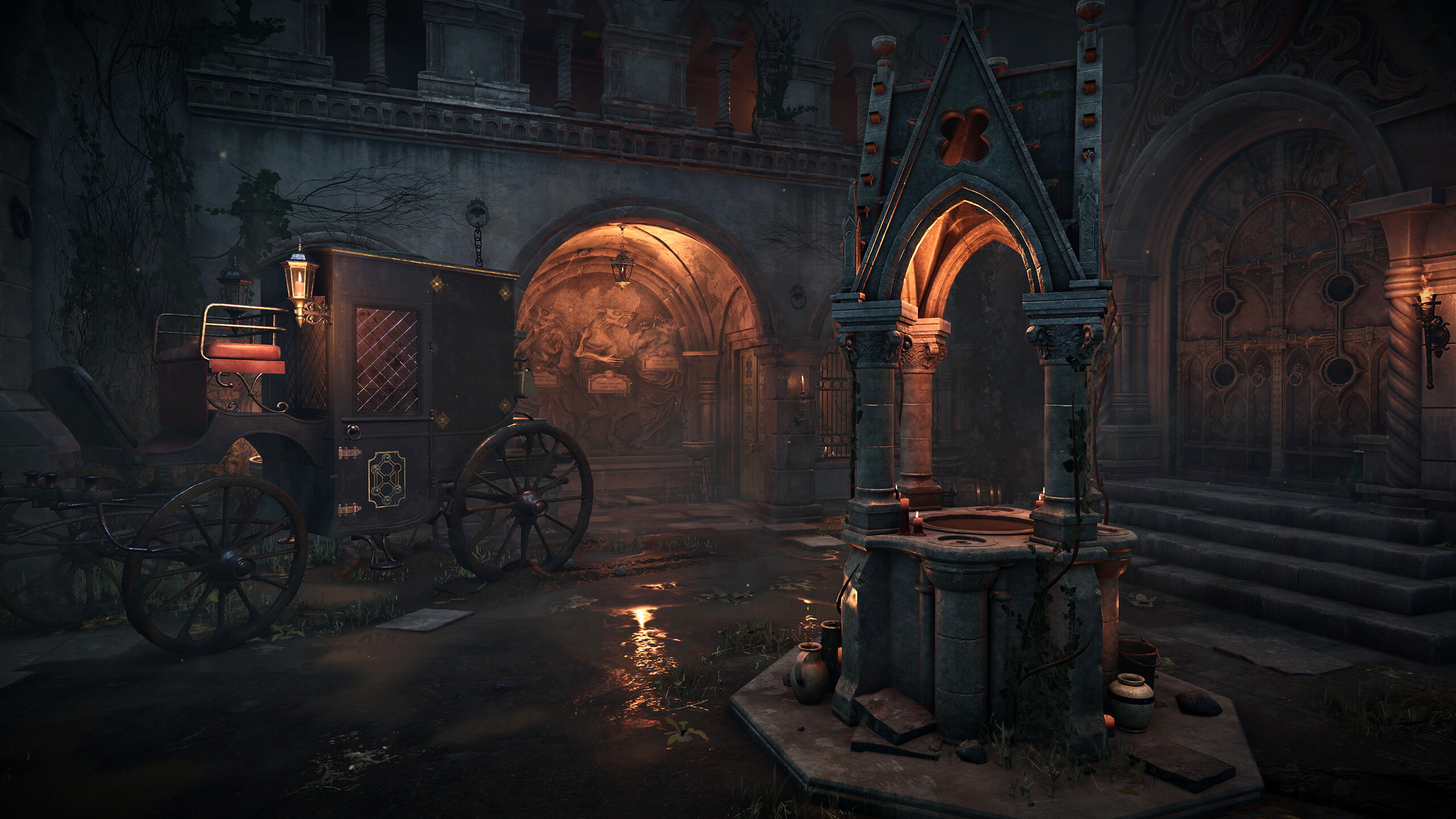
Isometric stealth action-adventure
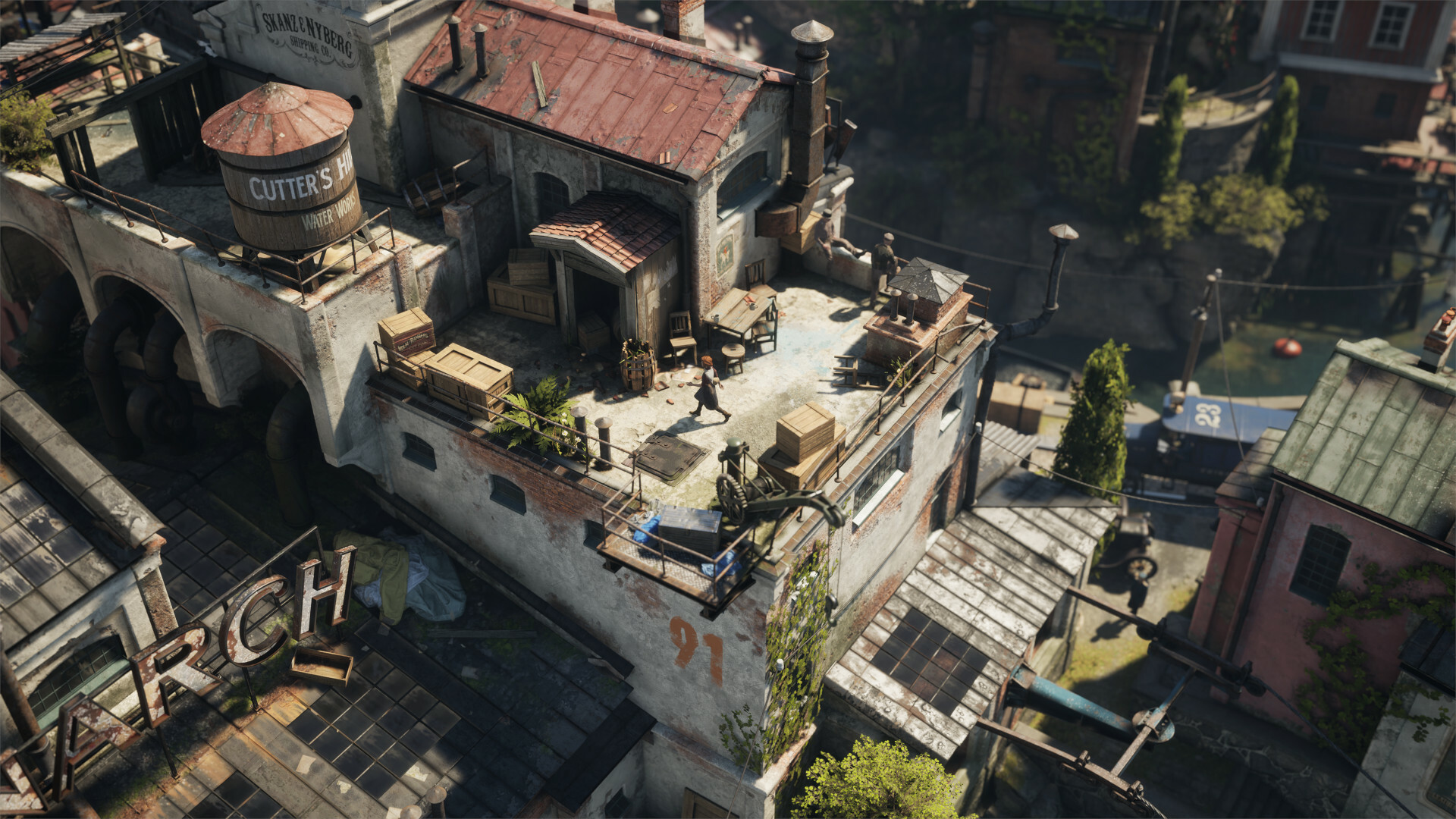
I was impressed with Eriksholm: The Stolen Dream. Victorian steampunk settings are nothing new, yet the sheer detail of each location and compelling actor performances drew me into this one immediately. The dialogue is natural and the writing is already on the better-than-average side of video games, both in and out of cutscenes. I was also surprised at the high graphical quality of those cutscenes (though mouth animations can look uncanny, like early AI attempts at replicating human faces). And I liked that while the levels were mostly linear, they often succeeded at giving me the illusion of an open sandbox.
This review contains spoilers.
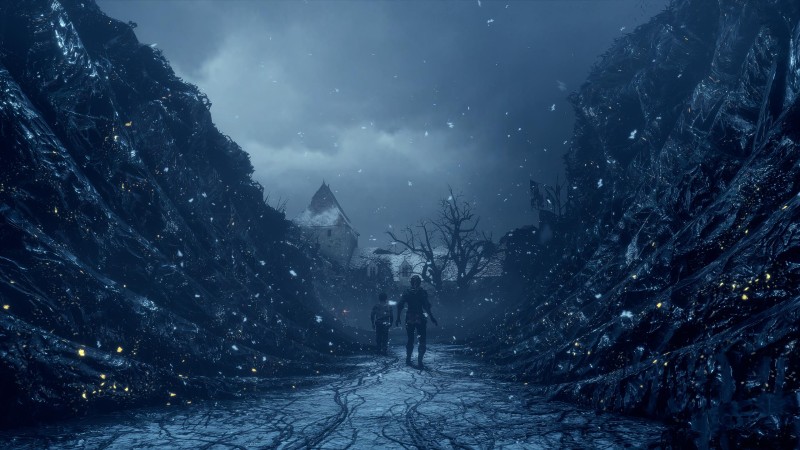
When A Plague Tale: Innocence was released in 2019, the action-adventure stealth video game was Asobo Studio’s first original production in a decade. The studio had spent those 10 years adapting children’s animated movies, and it shows. Innocence never challenges your thinking or complicates your feelings, despite presenting itself as though it would.
The subject matter is dark and sufficiently gruesome to have earned the game an M (17+) rating. It is filled with disease, mass deaths, and swarms of rats eating people alive. One might reasonably presume that adults are the target audience — yet aside the disturbing content, it is mostly written and designed as if for children.
Like basic adventure stories that move from one plot point to the next with no pause for character exploration, Innocence’s script is disappointingly simplistic, given what seemed like the promise of a mature story. The characters and themes rarely risk a close encounter with depth, and ludonarrative dissonance takes care of undercutting the few exceptions.
How does all this violence impact Amicia and her little brother Hugo? Innocence clearly wants players to sit with this question, but gives them nothing to actually chew on. In the end, all is well; there are no physical or psychological consequences, despite repeated and ominous warnings about Hugo’s use of rat powers. The game seems more interested in hinting that a sequel might have the answers.
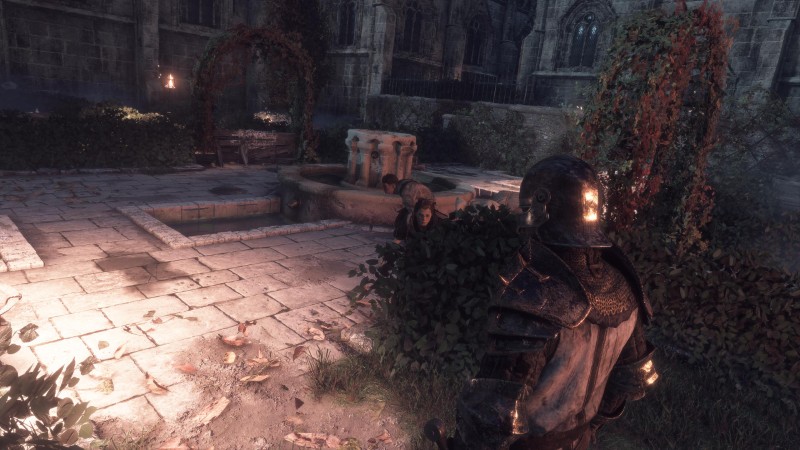
Unfortunately, the gameplay is just as bland. The hostile guards offer up a Greatest Hits compilation of every stealth game AI meme you’ve ever seen — they’re boneheaded, blind, and quick to forget nearby murder. The puzzles are easy enough to put even Skyrim’s to shame, and consequently just feel tedious to complete. Alchemical resources are overly abundant, always nearby when the game has decided you will need them for a concoction, even in places where it would make no sense to find them. Investing them to upgrade your skills does little to impact the gameplay.
Innocence may also be the only title I’ve ever played that bothers to give you new abilities as you progress through the game, only to strip you of any reason to use the old ones. Combinations and synergies are simply nonexistent. Then, in the climactic final fight, the opposite occurs: You cannot beat the cartoon villain by using any of the abilities you’ve learned throughout the game. The basic attack is all that will do.
If anyone ever asks you for an example of railroading in video games, you should point them to this one. Even in a peaceful castle that serves as your base of operations, there is precious little to explore. Everything feels like a watered-down version of a more serious story and more serious gameplay. The studio was inspired by The Last of Us and Brothers - A Tale of Two Sons, two games I loved, but it comes short of hitting their highs, though I did think the relationship between Amicia and Hugo was cute and heartwarming at times.
I played Innocence because it had strong reviews and I was hoping to show my non-gamer girlfriend that games could have mature, high-quality narratives on par with novels and film. It was a miss.
This review contains spoilers.
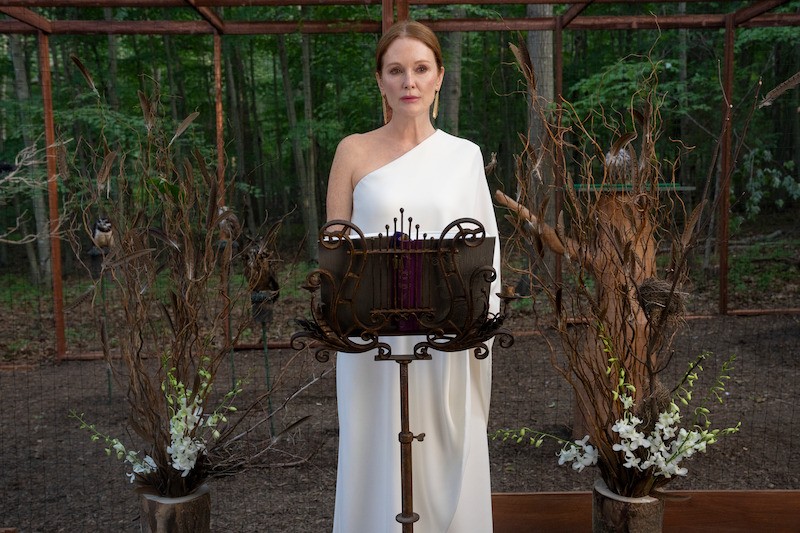
A woman attempts to rescue her sister from a cult whose leader may have supernatural powers.
If you began watching the Sirens miniseries on Netflix because you were intrigued by this premise, you may have been surprised by how the short five episodes unfolded. Just as a siren might lure an unsuspecting sailor down a deep dark ocean, show creator Molly Smith Metzler immerses viewers in a story with more depth and grit than seems on the surface — but one utterly lacking in supernatural elements.
Some viewers were disappointed. Perhaps the bait-and-switch was a tactic to get people sufficiently invested in the story to keep watching even after it turns out the show isn’t what it seems. But that would be doing it a disservice, because one of the story’s central themes is exactly that: things are not as they appear.
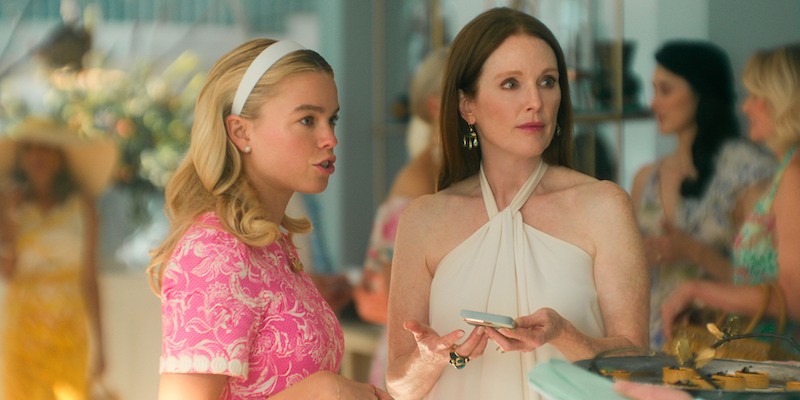
Most of the major characters in Sirens are terribly unreliable storytellers. In the opening episode, it is Devon who drives the narrative. She believes her little sister, Simone, to be in trouble — in the grips of Michaela, a cult leader and potential murderer. Consequently, the story is framed with that perspective, tinging all of Michaela’s actions with sinister intent, and serving as the hook for viewers.
But Simone is not in trouble. Devon, who saved her sister from their mom’s attempted murder-suicide when they were children, and subsequently spent years taking care of her, is only accustomed to perceiving Simone as being in need of rescue (and likely associates motherly attachment with murder). Simone is not actually in any danger, even if she is actively evading this extremely traumatic past. Michaela is rich, eccentric, controlling, and paranoid, but neither a cult leader nor a killer. She bears no ill intent toward Simone. She actually feels a kinship to her, having also lost her mom as a child.
After a tough argument with Simone, Devon’s perspective of her sister’s situation finally changes, and along with it the show’s framing of Michaela’s behavior, which becomes more positive and wholesome. Ironically, she is most like Devon: They were at a similar age when their moms died, and both have a caretaking streak. Michaela, like Devon, is genuinely invested in helping Simone, and also shows compassion for their dad, Bruce.
Bruce, who suffers from early-onset dementia, is another potential victim of unreliable storytelling. Simone tells Devon that their dad drove their mom to suicide through neglect. At age seven, Simone would likely understand little about the true circumstances that caused this tragedy, but Bruce’s neglect is what she herself experienced after her mom’s death — and it nearly killed her. So just as Devon believes her sister must be in trouble because that is the side of Simone she knows, it’s easy for Simone to believe her dad neglected her mom because that is the side of Bruce she knows.
Bruce, for his part, later says that, “Everything I tried, it just made [her] sadder. I didn’t know [she was] at that point.” He also suggests his wife had a challenging mood disorder. Regardless of his actual responsibility, Simone’s belief in his responsibility tells us more about who she is in the present than who he was in the past.
Another example of questionable narration comes from Peter Kell, Michaela’s billionaire husband. During a heart-to-heart, he tells Simone that Michaela estranged him from his children. At this point in the story, when Michaela is still the suspected primary antagonist, Sirens is working hard to frame Peter in a sympathetic light, and it’s easy to take his claim at face value. But later, when he brings this accusation to his wife directly, she reveals her own view: “You ruined your relationship with your children. You pursued me. You left Jocelyn. You let them demonize me.”
Who is right, and who is wrong? Sirens is not interested in doling out subjective answers. It would rather explore how the character’s past traumas alter their perception of present reality — and how they behave when that reality is challenged.

There is a scene in which Michaela gets Devon to express her guilt over abandoning her sister to go to college, and her grief that nobody took care of her as she was growing up. During this exchange, the camera on Devon — from Michaela’s perspective — is clear; but the view of Michaela — from Devon’s perspective — is increasingly blurred and out of focus, until the whole scene takes on a hazy, dreamlike quality. Michaela touches Devon’s nose, who then appears to regain consciousness much later, in a different place.
On the surface, it looks like trickery; confirmation that there are indeed supernatural elements at play — especially as it occurs at the halfway point of the show, before it’s entirely clear what Michaela is all about. But if she has any magic powers, it’s only in her ability to get people to open up.
As those who have done therapy may know, exploring trauma can be very like Devon’s perspective in that scene: Everything loses focus, the world closes in, and time passes without notice. You get stuck inside your own head and the body feels like some faraway thing. When your attention rejoins the world, it can be like coming out of a groggy sleep. Sirens exaggerates this for effect, but the idea is spot on.
Another scene that mirrors this experience is when Ethan, after Simone rejects his marriage proposal, accuses her of having pushed him off a cliff, grown wings, and laughed about his demise. This is an outlandish perspective, a consequence of drunken stupor and childish ego. Nonetheless, it is a parallel of the reality-bending that trauma can cause. Just as when severely drunk, trauma can make you perceive things that aren’t there, hurt yourself, and wake up later with unreliable memories and an aching body. It may lead you to say things that sound totally insane to everyone else — because to anyone in their right mind, they are.
Ethan’s drunk scene also features the out-of-focus camera from Devon’s confession, though much more subtly; the effect is used again, more noticeably, when Simone and Peter have panic attacks — yet another experience that can be linked to the feeling of trauma. The body comes under assault. The mind is hijacked. People who have panic attacks say that it can feel like dying.
We all have different experiences and perspectives in life. We have complicated, often competing emotions. We struggle to communicate. Achieving understanding, both of ourselves and of others, is an ongoing labor. And when trauma is involved, these normal human complications are intensified. What was once an emotional puzzle can become an incomprehensibly tangled mess. Communication becomes not just challenging, but potentially so triggering as to incapacitate. Memory is impaired. Reality takes on a new form.
Sirens gives us examples of how strongly individual perspectives can differ, and the difficulties that arise when those perspectives clash. How does one communicate with a person who, as soon as the critical subject is raised, completely shuts down? The show also tries to bring you on the whiplash ride of discovering paradigm-shifting information. For example, Simone’s withdrawal from her family can initially seem callous or even cruel, yet when we learn what she experienced at the hands of her father, it instead seems cruel of Devon to try to bring her sister back into his life.
Devon eventually processes this, but it takes her some time. Synthesizing differing realities is hard, and in Sirens, as in life, only some succeed at it.

When the show begins, it appears that Michaela and her posse of lavishly-dressed women are likely to be the eponymous sirens. Then, the two sisters lay a better claim to the title. The hypersexual Devon leaves behind a wake of desperate men; in one episode three of them chase her on the beach at the same time. Meanwhile, Ethan, a wealthy man known for serially ghosting women, proposes to Simone, who later has an even richer man leave his wife for her.
But not even the sisters have the sheer pull of Peter Kell himself. The Big Cheese. Thanks to his wealth and power, he is the true siren of the show.
Initially, it is Michaela who seems to hold the power on the island. A lot of it is exercised via Jose, the property manager, who is always nearby, ready to do her bidding. Gradually, it becomes clear that Michaela’s power is actually derived from her husband — crystallized when Jose refuses to help her pry into his affairs because, as he reminds her, he works for Peter, not her.
When giving advice to Simone on how to respond to Ethan’s proposal, Michaela tells her a personal story about the cost of becoming Mrs. Kell. “When you’re a Mrs. Somebody, your life get huge, but you get very tiny,” she says, adding if she were to get a divorce, she would lose everything that matters to her. “I work for him. We all do.”
Consequently, she guides Simone away from the wealthy Ethan, toward forging her own path — toward New York City, where she could chair Michaela’s foundation, build a career, and gain independence. One might conclude that if Michaela had a second chance — if she could go back 13 years to before she signed a disadvantageous prenup to marry Peter — she wouldn’t do it again.
Yet her own ability to give Simone career opportunities is directly derived from Peter’s wealth. And when Michaela acquires an incriminating photo of Simone and Peter that could help her pursue an at-fault divorce, she instead chooses to fire Simone and stay Mrs. Kell. Despite the downsides, the gravity pull of Peter’s fortune is simply too powerful to resist. When Simone eventually replaces her, she holds no grudge, because she understands the siren call of wealth, status, and power. “I had a good run,” she says. Now it’s someone else’s turn.
As for Simone, despite “worshiping the ground” that Michaela walks on, the latter’s ultimate value to her is as a door to Peter’s wealth — and through it, escape from her family. Simone’s lowest points in the show are when she believes Michaela will fire her, which causes her to have a severe panic attack, and when Michaela does fire her, which puts her in a catatonic state. Yet Michaela is not responsible for this distress, as Devon initially believes; rather, it is Simone who is unable to cope with her life off the island. In the end, rather than face her trauma, her solution is to bypass Michaela to go straight to the source of her wealth — even if it means stripping it from her.
Finally, the property staff complain endlessly about the difficult and stressful work, but also stick around. Patrice, the head chef, has been there long enough to cook for 16 annual galas. Jose has been with Peter for 19 years. He doesn’t think twice about destroying that incriminating photo for Peter, even when he knows it means Simone — whose departure the entire staff had joyously celebrated — will be staying after all. Despite the challenges, they remain loyal to Peter. Everyone wants a piece of the Big Cheese.
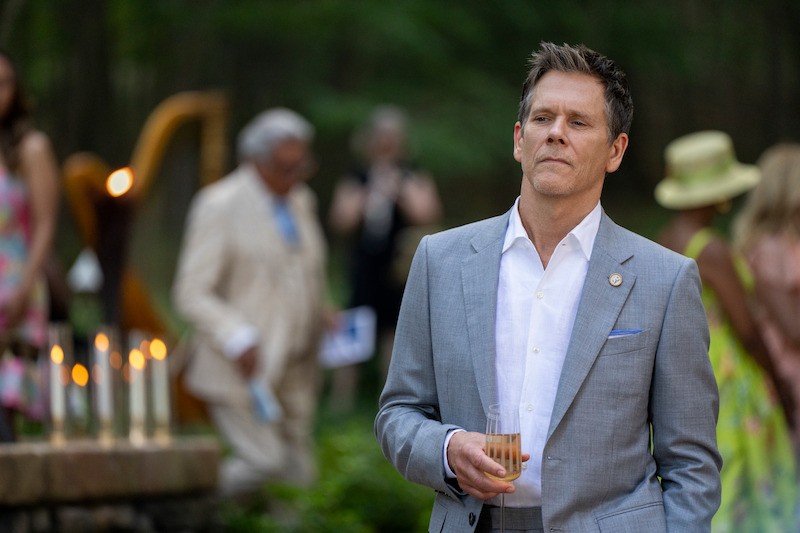
Peter, more than anybody else, does whatever he wants. He controls Jose, overrides Michaela’s rules about bread, convinces Simone’s family to stay with the promise of celebrity visits, takes the woman his best friend wanted to marry, and kicks out his wife during the gala she organized. The party simply goes on without her, as if she’d never been there at all.
Though he says he didn’t get to see his kids because of Michaela, it seems like a cop-out. In the beginning of the show, it’s easy to believe Michaela used her sinister, siren-like powers to lure Peter out of his previous marriage. But it’s more likely he let Michaela take the blame for his own choice to leave. Eventually, with age and a new grandchild, he gets to a point of wanting to prioritize seeing his family again, and so … he does exactly that — while conveniently blaming his wife rather than himself for not having done it sooner, and retroactively deciding that he was never really happy with her.
Peter doesn’t seem particularly villainous or even intentional in his manner. He glides through life, a bit high, a bit clumsy, a bit oblivious to his privilege in the way that people born rich usually are. Unlike Devon or Michaela — who have to messily figure themselves out as their realities clash with that of others, and who are eventually forced to learn and change — Peter can simply deny whatever he finds uncomfortable. If people don’t go with it, he can replace them with people who will. In a way, he’s not very different from Ethan. When they no longer find their women agreeable, they grow upset and call them “monstrous.” Ethan is clearly accustomed to getting his way, and so is Peter; he’s simply less dramatically petulant.
In a story that is all about trauma and perspective, Peter’s wealth buys him a luxury few can ever afford: to never have to leave his own reality. Money grants Peter refuge from rivaling perspectives, from ever having to do anything truly difficult, and the power to let go of anything or anyone he no longer likes. This is the escape that Simone pursues through him, but it is only a borrowed privilege, contingent upon remaining in Peter’s good graces. And it is the same escape that Devon ultimately declines.
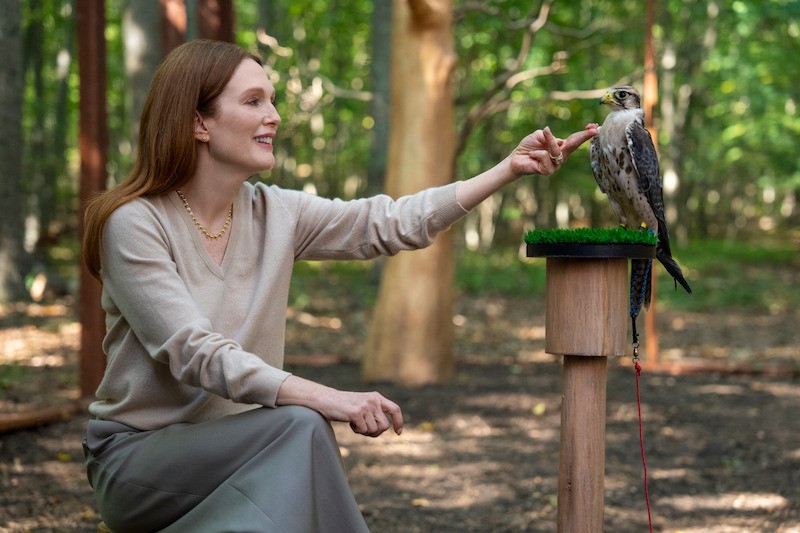
Throughout Sirens, Devon is presented with a choice: to escape with a sailor, or go back to taking care of her dad. (Ironically, it is the sailor luring the siren, not the other way around). She struggles with the decision because she cannot find peace either way, just as she could not find peace in abandoning or taking care of Simone when she was younger.
During her time on the island, Devon goes on a roller coaster of vulnerability, reflection, and change. Eventually, she recognizes the pride she earned in caring for Simone and is able to synthesize her conflicting inner selves. She accepts that caring for her dad is caring for herself, and she leaves the island feeling more prepared to do it.
Michaela can be seen as an older, more actualized version of Devon. She is also a caretaker, but unlike Devon, she is extremely comfortable in that role. She cares for raptors and acts as a quasi-therapist for both of the sisters and even their dad, including in difficult circumstances. When faced with divorce, she asks to keep the aviary. “Nobody knows how to take care of these birds but me.”
Simone, on the other hand, is rendered catatonic by the mere thought of caring for her dad (understandably so). Her trauma is too huge to accommodate the needs of others. So she escapes with Peter. She can be in his bubble, literally on an island of their own.
In the beginning, Devon comes to the island looking for Simone, who represents escape. What she finds instead is Michaela, and it is with her that she leaves, having finally made peace with her choice.
This review contains spoilers.
The followers of Kier Eagan, founder of Lumon Industries in the hit TV show Severance, bear a striking resemblance to real-life religious believers — from the weirdness of their rites to the abuse they inflict on others and themselves.
Fixated on the founder’s life, they shape language and traditions that reflect his words and deeds. They revere his texts and relics, produce symbolic art and propaganda, and refer to him as though he were still alive, exerting his influence. The descendants of Kier are said not to die, but to “revolve.” It is also implied that most, if not all of his Followers were indoctrinated as children.
A recurring concern for the Followers is “taming the four tempers” — Kier’s version of the seven deadly sins. These tempers (Woe, Frolic, Dread, and Malice), it is explained, are more than merely present in people. They are the complete building blocks of every human soul. As with Christianity, this belief in one’s inherent impurity creates the battleground for perpetual war between the spiritual mind and the sinful flesh — a war that, like Jesus, only Kier has had the strength to win, and in so doing was ascended above man.
Unbeknownst to them, the severed workers in Macrodata Refinement are soldiers in that war. Their assignment is to sort numbers representing the four tempers; in Mark’s file, these come from his wife, Gemma. Lumon has been subjecting her many innies to painful experiments, then asking her outie what she remembers of them.
Her final test is in Cold Harbor, a room designed to be as triggering to Gemma as possible. Lumon hopes that her latest innie will nonetheless be totally unaffected, thanks to Mark’s work. “Refinement” of the tempers, though its exact function is still unclear, seems at the heart of Lumon’s ultimate goal of eliminating suffering itself.
In biblical terms, sin is often at the root of suffering. And as with the most fervent Christian or Muslim believers, the Followers are not concerned with merely conquering sin on a personal level. Their calling is to purify the world. As Jame Eagen tells Helly in the first season finale, “They’ll all be Kier’s children.”
Because the severance procedure creates an innie, it is plausible they are identifying the composition of the human soul so that the severance chip can better delete it and thus create what is effectively a truly new human. However, it’s also possible that the temporal split is a separate function of the chip and that sorting the tempers serves some other, as yet undetermined purpose.
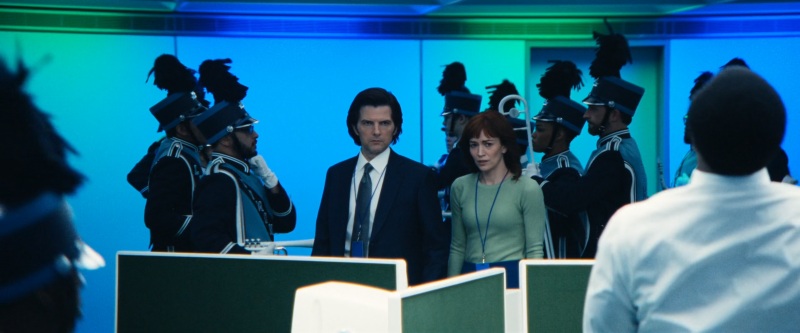
Religious themes and messianic figures are nothing new in fiction. A compelling element of Severance is that it shows how religiosity makes people behave in ways that can seem utterly bizarre to nonbelievers.
The constant references to Kier, the aggrandizing propaganda, and the obsession with structuring all things according to his example are no weirder than real-life theists praising their god at every turn, getting on their knees to pray, following rules from a book of myths, and generally shoving every aspect of life through a filter of religious interpretation. It can make them appear severed from reality.
Milchik is probably the clearest example of this. In the show, he serves as both an enforcer of doctrine as well as a victim of it. His striving to act according to Lumon rules overrides any possibility of genuine human connection, and leads to a tone-deaf attitude that is often inappropriate for the situation at hand — like when he aloofly hosts a “retirement” ceremony for a worker who has effectively died, or energetically dances to a marching band for the sake of someone who clearly has no cause to understand the fanfare.
In addition to showing little empathy, Milchik’s persistent inability to read the room not only confuses the severed workers but repeatedly enables them to take advantage of him. He never seems to learn they have their own agenda and aren’t playing by the same rules. This is typical of real-life believers, who often struggle to reason outside the framework of their faith. Atheists may be familiar, for example, with theists who genuinely can’t understand that claims about the bible or threats of damnation have no effect on them.
Most of the time, Milchik devotes all his energy in service to Lumon (the Church) and its doctrine. The myth, the rules — and the institution that upholds them — have supremacy over all. Including himself.
However, there are exceptions. Despite his efforts, he is only human. The suppression of normal emotion is unsustainable, and it is when that unnatural restraint fails that Milchik is at his most authentic. On those occasions, he is prone to expressing anger or annoyance, acting out against the severed workers who resist the doctrine, or against the superiors who relentlessly impose it upon him — such as when he tells Drummond to eat shit for making him apologize for his verbosity.
Drummond’s own fixation on Milchik’s choice of words might seem like targeted hostility, but is really a logical — if severe — carrying-out of a doctrine that abhors all excess. And in true religious fashion, doctrine is not only a thing to be impressed upon the naive — it must also be continually imposed among those who already believe.
Because any system that struggles against nature is inherently fragile. Nature will always resist. The system must be enforced at all times, lest it fall apart at any moment.
In their ongoing effort to “tame the four tempers” and adhere to Lumon code, the Followers thus police themselves and each other. They attempt to express themselves only in the prescribed manner and in prescribed doses, striving to be like the severed floor — the physical embodiment of Lumon’s ideal mind: cold, organized, compartmentalized.
Like the indoctrinated of our own world, Milchik is smothered by his own system of belief. He may occasionally find the strength for a gasp of air, for the briefest moment of assertion — though as is usually the case for those in his position, overthrowing the system itself is simply unimaginable.
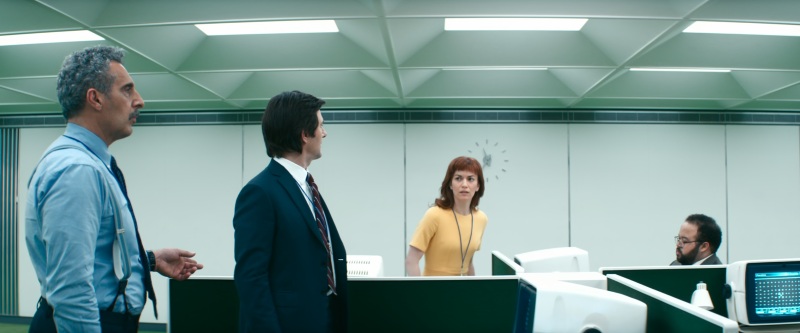
While their minds are blank and thus fertile for religious influence, the innies are actually too raw to be properly indoctrinated. Their newness in the world endows them with the innocence and liveliness typically associated with children — who in our real-world religions are also absolved of sin, as they are too young to understand right from wrong.
Almost paradoxically, this causes the innies to be the only characters in Severance who truly embody Lumon’s nine core principles (mirroring the Christian seven heavenly virtues), such as cheer, humility, nimbleness, and wit. These virtues exist in the innies more than in the Followers of Kier, more than even in their own outies, who are themselves shown to be living drab, depressing lives.
Concurrently, it is the Followers who most lack the core principles. Though they have not undergone the severance procedure, they are nonetheless severed from their own selves. They are dogmatic and traumatized; shells of human beings whose innocence and healthy emotion have long been lost.
Harmony’s aunt tells her that as a child, she had the “fire of Kier” within her; yet in adulthood, she lacks all liveliness, speaking almost exclusively in low, monotonous tones. “Frolic,” the only cheerful of the four tempers, is tattooed on Drummond’s hand, a man without an ounce of gaiety. When Milchik or Natalie smile, there is no warmth in it. Jame Eagen, expressing the impact of Helly’s betrayal, says he “threw a tin of candies” to convey how badly he lost control. (As she says in response: “God, you’re fucking weird.”)
In Lumon’s demand for absolute control, the spirit of life itself — the “fire of Kier” that it so values — is precisely the thing its Followers must kill; just like the “verve” that Drummond seeks in the lamb only makes it eligible for slaughter.
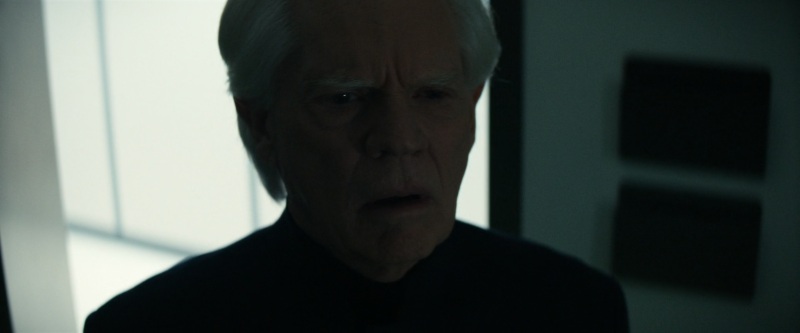
Jame also tells Helly that her outie once possessed that “fire,” which “left her as she grew.” Yet he witnessed the fire in Helly, the version of Helena that happens to be free of religious doctrine and abuse. This alone seems to have been enough to draw him to the severed floor so that he may see her, mouth agape, the way a tired, jaded man can find dreamlike beauty in a child’s innocence.
Is it a coincidence that Helly — the least reverent of the severed workers, who routinely laughs and scoffs in the face of Kier propaganda — is the spunkiest of all the characters in Severance? And that her shambling father — the highest living representative of the religious cult — has the least fire of them all?
This again highlights the unwinnable struggle at the heart of those religions that propose a good life requires opposition to one’s own sinful nature. In the biblical narrative, man doomed himself when he ate of the fruit of knowledge of good and evil. He must strive to do good, but a life truly without sin — and thus without suffering — is reserved only for the likes of god.
Man can only experience genuine innocence and be free of suffering when without the knowledge of good and evil — a luxury afforded only by young children, shortly after life begins. To be pure, to be without the suffering that comes from sin, one must therefore be reborn.
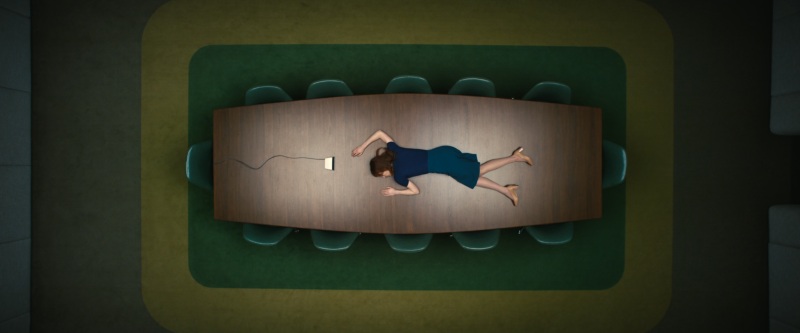
Or severed.
There is a card in Slay the Spire, the excellent roguelike deckbuilding game, called Claw.
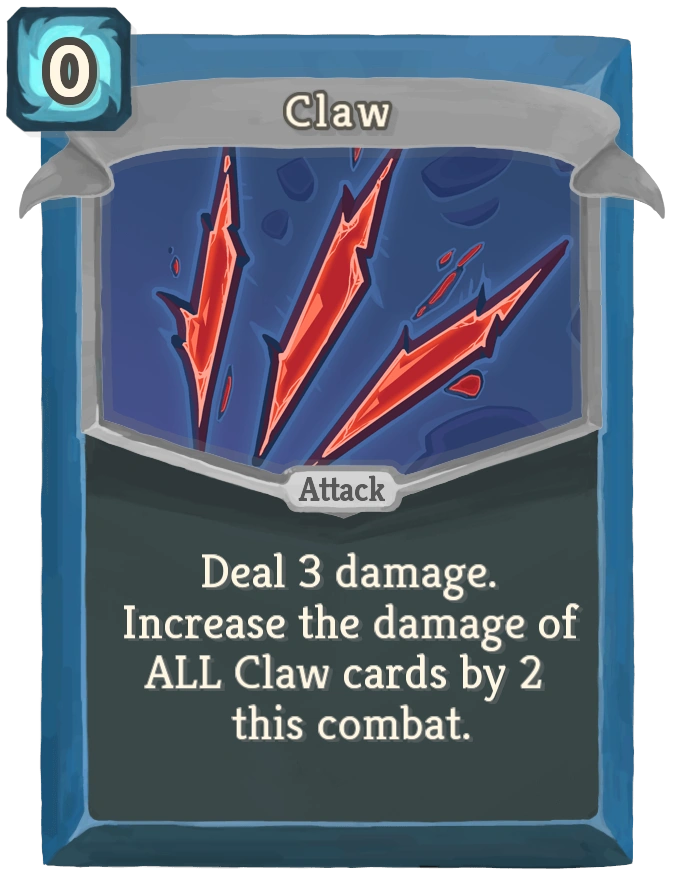
Viewers of Slay the Spire content love to parrot that “Claw is the law,” which is to say that when Claw comes up, you should take it. The reason is simple: it’s a fun card that holds a promise of big numbers.
Unfortunately, it’s also not very good. (And that’s another part of why people like to see it. It’s not used often enough to get boring.)
Upon first play, Claw deals 3 damage to a target. Each time it is played, the damage of all Claw cards in your deck goes up by 2 for the remainder of the fight. So, in theory, it scales infinitely. Claw incentivizes you to pick up a few more Claw cards and play them as many times as possible.
However, the initial damage is quite low, and it takes a good number of uses before Claw becomes a card worth playing compared to other damage options in Slay the Spire. So until you build a deck that quickly and reliably enables you to find your copies of Claw, and allows you to find ways to play them repeatedly, it’s more likely to be dead weight.
In Slay the Spire, you typically can’t afford to wait until you’ve put together all the pieces necessary to make a Claw deck work. If your deck isn’t strong now, you’ll probably die before you get to later. You can rarely afford to put dead weight in your deck.
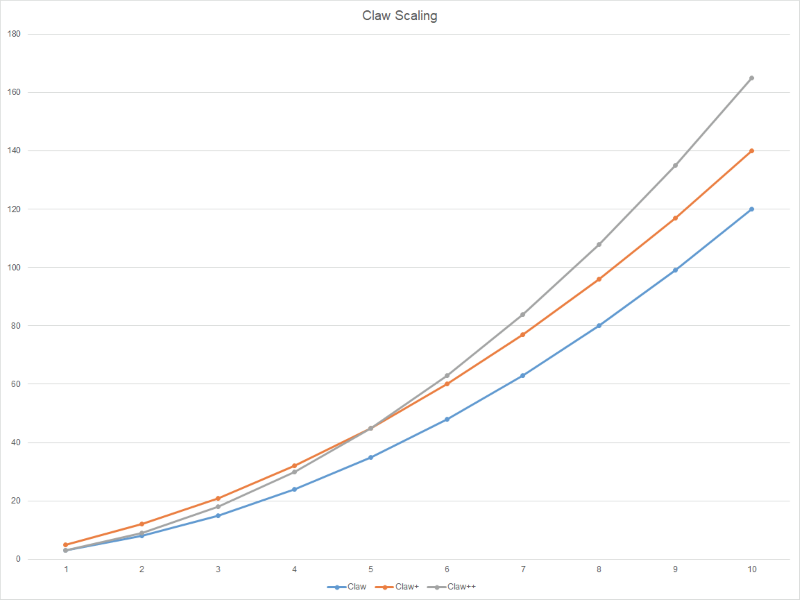
Claw can also be upgraded into Claw+, which is why I’m writing this post. In the game, you can visit campfires where you may choose to rest (to regain health points) or upgrade one card in your deck. Claw’s upgrade is mild: it raises the base damage from 3 to 5.
Many people find this underwhelming, and think the upgrade would be better if instead, it made Claw scale more dramatically. For example, the card text could say: “Deal 3 damage. Increase the damage of ALL Claw cards by 3 this combat.”
But I don’t think this is a very good upgrade. The current Claw+, after five uses, will have done 45 damage. Theoretical Claw+ (let’s call it Claw++) will also have done 45 damage. So Claw++ would only be better than Claw+ after a minimum of six uses.
In a deck that makes Claw work, you can expect to play Claw far more than just that. In late-game boss fights, you may even play it 30 times or more, at which point Claw++ would obviously deal vastly more damage than Claw+.
However, the whole problem of Claw is that your deck will likely have failed before then. You need substantial card draw and deck manipulation, energy generation, or at the very least sufficient defensive capabilities to stay alive until Claw finally starts doing something worthwhile.
If you manage to play Claw 30 times, great. At that point, even an unupgraded Claw is still doing incredible damage. But Claw++ not only doesn’t help you in the early game, where Claw is most likely to be a bad pick, it’s actually worse than Claw+ due to needing a bit of extra time to ramp up to overcome the low initial damage.
I also don’t think the regular Claw upgrade is as bad as people say. If picking Claw means building a deck that revolves around playing Claw as many times as possible, then surely increasing the base damage of the card isn’t that bad. It’s only an additive upgrade, but it multiplies with how often you play it. Of course, it effectively only starts you one step ahead on the ramp, which is to say it’s equivalent to playing Claw one more time. So if you have other upgrade options that help you play Claw more often, they’re going to be better.
So what’s the point of all this? Claw is fine the way it is. Part of what makes it fun to use is the difficulty of winning with it. If it were changed to have better scaling, it would just get better at what it already does well: do a lot of damage once played many times. And if its early damage was shored up, then its only real weakness would be eliminated and Claw would likely be overpowered. Then Claw would really be the law, and that would be no fun at all.
Think upon a time
Of peace and awe; soaring eyes
Across stars divine
(Written during Christmas at a cabin in north Georgia)
Half’s a day arc the sun had yet to trace
When a man on the hill approached its crest
Only chance had led him atop this place
Which now called upon him to breathe and rest
Hard had been the way and many leagues in all
Yet when o’er his shoulder he strained to turn
The road he saw spanned short by his recall
And to this path he sensed he’d not return
Before him now waited lands lush and green
Where far-off miles like rivers sighed and curled
They seemed to hold a promise true and clean
And in his heart a sweet new life unfurled
He closed his visor and shifted his weight
Then with a smile rode down to seize his fate
In the wake of the 2024 U.S. and Mexican Grands Prix, where Max Verstappen made a handful of cynical defensive and attacking moves against title rival Lando Norris, I’ve seen surprising support for the idea that Verstappen is not a good wheel-to-wheel racer — and apparently never has been.
Some of his moves are unquestionably unsporting, but to say this is a consequence of his inability to do otherwise is clearly untrue. Like other “dirty” drivers before him, Verstappen drives on and over the limit of the rules when it’s to his benefit, not because that’s the only tool in his toolbox.
Heading to Mexico, Verstappen was ahead of Norris by 57 points in the 2024 Formula 1 Drivers Championship, with five full races to go and two sprint races. In most seasons, this would be an insurmountable gap to close — but in 2024, there’s more than a mere outside chance of Norris overtaking Verstappen. The former’s McLaren is the fastest car on the grid, while the latter’s Red Bull has been third at best. If Norris finishes 1st with Verstappen 4th in every remaining race, Norris would win the title.
So Verstappen is now in a situation similar to the final rounds of the dramatic 2021 F1 season: driving a slower car than his rival, and desperate to minimize the hemorrhaging of points. This is when his driving pushes the limits of sportsmanship — when there’s a tactical advantage to it. When Verstappen has a car capable of fighting for wins without an overwhelming disadvantage, his wheel-to-wheel driving tends to be impeccable. It’s when, in the pursuit of a championship, he has no recourse other than desperate maneuvers that we see him make moves like in Brazil 2021 or Mexico 2024.
And critically, the moves hit their mark. At the Circuit of the Americas, Verstappen actually extended his championship lead over Norris. And in Mexico City, even after receiving a 20-second penalty for his unsporting move, he still managed to stem the bleeding of points.
Had he not held up Norris in that manner, there’s a good chance his rival would have won the race, resulting in a gap of 44 points. As it happened, Norris finished 2nd with Verstappen 6th — fewer points for Verstappen due to the penalty, but the gap is 47 points. It could easily have been as high 50 points had Charles Leclerc not been unlucky with backmarkers, which helped Norris to catch and pass him in the closing laps of the race.
So regardless of how ugly it was, it did make a positive contribution to Max Verstappen’s title fight. It’s ruthless, but it’s also precisely that ruthlessness that is, in the eyes of many, a key ingredient to winning world championships.
Indeed, when Norris races meekly, many F1 fans complain he doesn’t have the fight necessary to be a world champion. But when Verstappen races fiercely, they complain he goes too far. Verstappen merely does what he needs to win, and that’s not just a common goal among F1 drivers — it’s also their job. Millions of dollars and thousands of team personnel depend on their success. If viewers don’t want to see that kind of racing, then it’s the role of the stewards and the racing regulations to discourage it. It’s not the role of the drivers to leave points on the table for the sake of being nice to their competitors.
When a professional soccer player commits a tactical foul in the 90th minute to prevent an opposing player from scoring and eliminating their nation from the World Cup, spectators say: “Easy red, but fair enough.” Everyone agrees it isn’t sporting, and the player may even be called dirty — but fans also understand he did what was needed for the greater good of the team.
Verstappen is rarely afforded the same grace. Formula 1 fans call him dirty but seemingly without understanding the tactical side of it — or that part of the reason he’s paid $55 million a year is that he’s very good at it.
The river flows proud
And cannot look back to see
It comes from many
(Written in Atlanta woods near the South River)
“People pleasing” is a term people use, usually about themselves, to describe seemingly self-sacrificing behavior for the sake of others. There’s not a lot of stigma around calling oneself a people pleaser, because the underlying message is usually that one is “too nice.” It’s almost a humblebrag.
But it’s not a nice thing. It is, fundamentally, self centered.
I’m a people pleaser. Like most, I grew up around a person who was a threat to my wellbeing if I did not tend to his needs. Consequently, I became extremely sensitive to other people’s negative emotions, which serve as a kind of alert that I should be very careful. Negative emotional states have a nasty way of making me feel very anxious. If you’re in a bad mood, I can tell. Sometimes even before you.
Except that’s not entirely true. The adaptation works even better if one simply assumes that the people who can hurt them are always in a bad mood and prone to exercising their destructive power. Then one will always be careful and never make the terrible mistake of assuming one is safe.
The product of this constant fear, which one might call anxiety, is “people pleasing.” At any given time, I may feel in emotional danger if I have not done enough to prove I am worthy of being loved by those around me. So I act nice. I remain polite. I minimize my needs and invest energy into things I don’t believe in. How much is enough to guarantee safety? There’s no way to tell; easier to assume it never is.
This is the basis of people-pleasing behavior. It is a defense mechanism in service of the pleaser. It is therefore not altruistic in nature, but self-centered. Pleasing people out of an anxious compulsion to protect oneself is not the same as pleasing people out of genuine care for them. It’s common to act as though the behavior is a kind of tragic self-sacrifice for the benefit of others, one that hurts only the pleaser. This is a misconception.
People pleasers do sabotage themselves, it’s true — but they do not do it for the benefit of others. They are attempting to benefit themselves; and the real cost, what is truly sacrificed, is authentic relationships.
For about a decade, I have been writing content for The News Wheel, an automotive news website owned by my company. It’s shutting down in two months, and hundreds of my articles will go to the void.
My company provides logistic and marketing solutions for dealerships, and part of the marketing packages it used to sell to dealers included TNW articles that link back to their own websites.
For the better part of 10 years, my team wrote monthly content — typically about current car news — plugging 1-2 relevant links that sent readers to the dealerships. We generally kept the content related to the brands sold at those dealers (I focused mainly on Toyota and Honda) but there was flexibility, enabling us to also write evergreen content and, in my case, about Formula 1, which I greatly enjoyed.
Though TNW posts were included in our premium marketing packages, for many years we still wrote them for dealerships that only had the standard package. It was technically a free bonus for them, but we wanted to grow the website, and that required content.
It worked. Prior to COVID, we wrote over 100 pages for TNW every month. I personally wrote about 30 on average. The website was steadily gaining in readership, at one point earning about 600-700k clicks per month. It felt like the million was coming.
It never did. We had no shortage of creatives capable of producing well-written and entertaining content, but TNW’s greatest weaknesses, in my opinion, were its presentation and navigation. Over the years, some minor suggestions of mine were implemented, but adequately addressing the more fundamental issues would have required a level of investment the company was not prepared to make.
In the early days, we cared enough to pay for a user feedback service. It had a silly name I can’t remember. Anonymous users would be invited to record themselves browsing our website, talking through their actions out loud. This was intended to help us identify user experience issues.
I think it makes a lot of sense to care about UX, so it was always strange to me that when we reviewed these surveys as a team, the common group reaction was to laugh at the often-confused readers. Instead of taking their feedback seriously, we dismissed them as being clueless internet users and changed nothing. I was concerned about this and expressed it to my supervisor at the time; not long after, we simply stopped using the process altogether.
I could say the company didn’t want to continue paying for it, but realistically, the larger issue was that there wasn’t much to do but laugh at the befuddled users. We didn’t actually have the means to implement meaningful changes, so there was little use in discovering common user pain points in the first place.
Indeed, to the many suggestions I made over the years, the most typical response was that they were not technically feasible due to back-end limitations. We didn’t have the tools for improving website navigation, and the company was never going to give us those tools. That would have taken money. The obvious futility of trying to make the site better ultimately fostered a culture of apathy.
Then, we stopped writing TNW posts for the non-premium packages. We’d lost team members over the years, they hadn’t been replaced, and job responsibilities were shifting around. We no longer had the overhead to write extra content, and TNW wasn’t being prioritized. To make matters worse, COVID majorly disrupted the auto industry, and many dealerships chose to cancel services. We didn’t have many premium customers. I went from writing 30 pages for the site every month to writing about three. Some writers on the team no longer wrote for the site at all. TNW had been stagnating at this point, but this was a killing blow.
The bulk of the readership quickly went away and what little is left has been on a steady decline. TNW currently gets about 50k clicks per month, mainly from old posts still rating well on Google, and it’s not getting any better — despite a vague, almost ceremonial requirement that everyone on the team write two bylines for it each month. About a year ago, some higher ups, who didn’t even know about TNW for some reason, realized it existed and came to us asking for ideas about how to squeeze all the advertising potential out of it before they discontinued it. I suggested the best way to maximize the ads would be to invest in the site enough to grow the readership again, exposing more people to the ads, but that type of long-term planning is anathema to our corporate overlords, particularly in the marketing sector.
As it stands, my company will stop paying for the site in December, after which about a decade’s worth of content will vanish. I don’t know exactly how many articles I’ve written for TNW , but it’s easily in the thousands. Most of them are inconsequential, but I’m proud of a good number of them, as well as of the content written by my coworkers. I’m sad that the only thing left of all that work will be whatever we back up on our personal devices.
All creatives encounter a familiar difficulty: how to remain motivated about creation without an audience?
The answer is always the same. One must find the work intrinsically motivating. Write because you enjoy the process. Play music because you like how it sounds. Etc. Don’t do it for the likes, the views, the feedback, do it because you like it for what it is.
It’s not bad advice, but it’s imperfect. I can play music for myself fairly easily. But blogging? The whole purpose of this type of work is to have an audience. Nonfiction writing, in general, is not about the process. It is a form of communication. Film reviews are meant for moviegoers. Baking recipes are meant for people whipping up something in the kitchen. A piece of in-depth journalism is intended to inform. These have limited entertainment value for their creators compared to more artistic endeavors.
Activities like blogging, streaming, and podcasting are fundamentally self centered. They say, “What I do has value and merits being shared with the world.” The extent to which that is true is then measured by the attention and engagement of readers, viewers, and listeners.
That’s not to say the act of creating a piece of nonfiction can’t be fun. Investigating some political intrigue can be thrilling. Experimenting in the kitchen and coming up with a new recipe is exciting. But once you step beyond the point of creation and into the realm of sharing that creation, it becomes something else. Experimenting in the kitchen is just cooking. Sharing those experiments on a blog is blogging. And even if you enjoy cooking, it can be hard to find the motivation to blog about it if nobody cares about your recipes.
If you can’t garner an audience, you just have to be able to enjoy talking to yourself.
Formula 1 drivers are great athletes and deserve plenty of credit for their abilities. But one of those abilities is not fast reaction times, and it bothers me to no end that people continually act as though F1 drivers have supernatural reflexes. They have regular human reaction times like the rest of us, and the fact that people think otherwise says a lot about their misunderstanding of expertise in general.
The average person has a reaction time of 200-300 milliseconds. The Human Benchmark website says the average score on its reaction time test is 273 ms, though it likely skews high due to interface latency (with a high refresh rate monitor, I scored an average of 171 ms).
F1 drivers are in the same ballpark. The race broadcast often shows the time it takes for drivers to react to the starting lights, and the top starters are usually in the 200-250 ms range. Yet a lot of fuss is made about their reaction times, as though they’re part of what it takes to drive a twitchy, 200-mph racing car. And not only is that wrong, it undermines the actual skill that F1 drivers do have.
The true skill is anticipation, and accurate anticipation comes with expertise. All professional athletes seem to have incredible reflexes when applied to their discipline. That is the product of being expertly aware of many possible scenarios, and of being trained to act appropriately in these scenarios. This enables experts to be prepared to act when something does occur. To the untrained eye, that preparedness can very easily look like natural reflexes.
When a car unexpectedly comes across an F1 driver, and that driver seems to react with supernatural speed to evade the accident, a casual viewer may be stunned at the quick reaction. Yet that is only because the viewer is operating with far less information than the driver. The driver would have been far more likely to see the incident coming, due to his superior ability to read his surroundings and predict other drivers’ movements. In other words, he sees things that the casual viewer does not.
Casual viewers, blind to what they does not see, too often make the mistake of assuming they are operating on the same level of awareness as the driver. Thus they conclude that the driver’s superior ability to react to a situation comes from his superior reaction times, rather than his superior awareness of said situation. But in situations where just a few milliseconds can make a difference, if you are at the point of purely reacting, it probably means you weren’t paying enough attention to begin with, and you are already too late.
You can apply this to your own driving on regular public roads. If you are attentive to your surroundings and paying attention to other drivers, and if you have a good sense of how your vehicle behaves, how to control it, and how other vehicles can behave, then you will be much better at anticipating potential trouble; consequently, you will be a lot more adept at handling that trouble.
If your awareness helps you avoid an incident on the road with passengers on board, they might then commend you on your good reflexes, rather than the effort you put into being a good driver. This is because people have an inaccurate tendency to attribute skill to natural talent rather than to work and discipline. As mentioned above, this is because they can only see the situation from their own point of view — from the point of view of a layman, not from that of an expert who has put in the work. Therefore, in their shoes, to do what the expert seems to have done, it would have taken exceptional reflexes. But to do what the expert has actually done, it would take an entirely different brain.
A young man looked often upon the stars
Entranced by the moon’s light embrace
And dreaming of love that seemed just as far
Long have those wistful days been left behind
He has forgotten his father’s face
And far indeed has traveled since that time
Till quite by chance, from a tale grim and old
Sprung forth an unexpected grace
And bore dreams lost in his neglected soul
Clouds broke before a familiar moon full
The deep void now but a short space
And fading in a heart finally whole
A reddit post asked what people would do if they were the last person of their sex left on Earth.
It was full of stories about how the last man would either have the time of his life, or be drained by a machine for the rest of his days, or be carelessly raped by lustful women because sperm banks would still be around, and thus the world would have all the material needed to repopulate without him anyway.
The stories about the last women were just as grim, if not more. Virtually every responder couldn’t conceive of a worse life, imagining an existence of endless and violent sexual abuse.
I’d like to believe in another story. I think it could turn out well, if you were the last woman on Earth. Humanity can do incredible things when it has to. It’s not difficult to imagine that most would recognize the sheer precariousness of the situation, and collectively agree that the survival of the species literally hinges upon that single woman’s wellbeing.
Thus the last woman on Earth could very well become a near-deity. As the only hope for humankind, She would need to be protected at all costs, lest all be doomed. Humanity’s primary project would be to ensure Her health and fertility. She would get the best possible care. And for the sake of reproduction, male partners would have to be very carefully selected.
Men abusing Her at will, as redditors seem to think would happen, would be a terrible long-term strategy for producing healthy children. It would be wiser to tend to Her wellbeing as much as possible, and I fully believe that most of mankind would recognize the importance of this.
Being perpetually pregnant until menopause would be very difficult, of course — though not unlike the experience of millions of women before contraception existed. Except, in this case, a lot more social energy would be devoted to ensuring Her care, and She’d have all the benefits of modern medicine at her disposal, as well as all the help in the world with Her (female) children.
Ultimately, She would likely have a good life and be remembered forever as the Mother of mankind, the most important person in the history of the world. We already have ancient myths and cultures that glorify and semi-deify women for their ability to bear children. I don’t think it’s too much of a stretch to imagine that if there were only one left, She would become the closest thing to a Goddess we’ve ever had.
(I’m sadly less optimistic about the whole story once fertile daughters enter the picture).
All the sound generators are connected via TRS audio cables to a mixer, where their outputs are merged together to taste. The output of the mixer then goes to the computer via an audio interface. From there it goes out to the speakers. There’s a hilarious number of volume knobs that each signal passes through.
It also takes a fuckton of cables. I’m currently using 1 XLR cable and 13 TRS cables. It’s about $10 each so let’s say $150 after tax. I also paid $125 for a used Mackie Mix12FX mixer, which is on the low end. I won’t include the cost of the audio interface because you’d probably want one even if you’re fully in the box (doing everything in the DAW).
Total audio cost now: $275 Total audio cost future: $325 because I anticipate having to buy at least five more TRS cables for future synths and devices
The sound generators also need to know what notes to play, which is passed via MIDI data. All of them can both send and receive MIDI. MIDI can be sent over USB, but this typically introduces jitter as well as noise, and is best avoided. Some synths have a MIDI-Thru input that makes it possible to daisy chain devices, but that also has its complications. The best and simplest method is to use a MIDI hub.
Simplest doesn’t mean simple, though. I want to send note data out to all my instruments with my MIDI controller. But I have more than one possible source of MIDI data. The computer can also send MIDI data. So can my piano. And if I don’t want to send that over USB, then I need a way to both merge multiple incoming MIDI signals, as well as split the result into multiple outgoing signals.
There’s a MIDI hub device I could buy that solves all these issues. It’s $180 for the smaller budget version. I just have a $53 splitter box for now and dealing with USB when I have to. It’s about $7 per cable and I am using five, so that’s another $35.
Total MIDI cost now: $88 Total MIDI cost later: ~$250. I could sell the current hub but I’d probably keep it, could be handy
As mentioned, it’s preferable to avoid USB. Even if you completely avoid using it for MIDI, it still adds noise to the system. My TR-6S, for example, is quite noisy when plugged in via USB, even though it has a Ferrite choke. My piano’s USB connection is also noisy. However, there are still reasons to use USB. The TR-6S is powered by it, and it churns through four batteries quite quickly so it’s not feasible to keep it unplugged at all times. My Minibrute 2S has settings that can only be configured on the computer when connected via USB. If I want to manage patches or add new wavetables to my Novation Peak, I need USB. My MIDI splitter hub is powered by USB. So is my audio interface.
In other words, a USB hub is needed, and one with a good number of inputs. About $30. And not all of these devices come with the necessary USB A-to-B cables, especially when purchased used. I’ve had to purchase two for about $20 total.
Total USB cost now: $50 Not sure about future.
Even with a well set-up mixer, audio connectivity is still a hassle. My Mackie Mix12FX mixer has a single mono FX output, which is currently going out to my single Pro Co RAT distortion pedal. The output of the pedal is plugged back into one of the mixer’s inputs. This is a basic FX send setup. But what if I want to change it? The Peak and TR-6S both have built-in distortion effects, so what if just wanted to insert the RAT into the Minibrute’s signal chain only, instead of using it as a send? Then I’d have to do a bunch of rewiring.
I eventually intend to get a sampler and some Eurorack modules. This will inevitably involve sending the output of some of my other devices to their inputs. Again, more rewiring needed, and there will not be a single fixed solution. The ability to make break connections and make new ones needs to be built into the setup.
That means getting an audio patch bay. More money spent, more space used, more cables required. Looks cool though. I’ve done a mockup and determined that with my planned setup I could use almost all of the patch points in a 48-point bay. Costs about $130 and another $35 for 8 short cables.
Total patch bay cost now: $0 Total patch bay cost future: $165
If you’re going DAWless, you’ll need hardware instruments, and that means you’ll need a place to put them. I’m just working at a single desk and don’t have the room to expand beyond. I’ve managed to really maximize the space with mounts, including wall mounts. I raised my speakers to give myself more desk space. I mounted my primary monitor to the wall to make room under it. My mixer is stuck to a monitor wall mount with command strips so it uses far less space while still being movable. I bought a KVgear mount to stack the Minibrute above the Peak on my desk.
There’s a lot of options here, but for me that was about another $190.
So I’m looking at about $600 spent so far just for the sake of DAWless connectivity. No synths, no pedals, no keyboards included. None of the fun stuff. And I may spend an additional $330 for a total of $930 to make the setup properly usable, accessible, patchable, and convenient to use without having to constantly redo cable management or pull things in and out of storage.
And that’s only half the price of a small Eurorack setup! LOL this hobby will financially ruin me

Nobody really knows how to identify “good” wine. Slap a fancy label on a cheap bottle and, upon tasting it, people will describe it using terms like “complex,” “rounded,” and “woody.” Serve the same wine, this time with the original label, and it will suddenly become “flat” and “weak.”
These are real quotes from a 2001 study, and there are plenty more that show the same phenomenon. Expert wine reviewers can’t even tell the difference between white and red wine. I’ll leave you with this great article if you want to read more.
It’s the same in the music production industry. Try to find any review of an analog piece of gear without hearing the term “warm” or “vintage.” Impossible. Yet in a blind test, people can’t accurately identify one synthesizer from another. Most can’t hear compression at all, let alone the difference between a digital one and an authentic 1176 — yet the internet is positively rife with analog compressor emulations, all claiming to be the one that will finally take your mix to the next level due to its unique acoustic properties. It’s snake oil.
We experience what we expect, and we like what we’re already familiar with. Confirmation bias and the placebo effect constantly work against us to undermine our perception of reality. As soon as you gain even the tiniest bit of insight into what you think something is supposed to be, it changes how you experience it.
There are differences between synthesizers, of course. Their signal paths, interfaces, and features all vary. But in terms of the raw sound, they are subjective differences that cannot be given any sort of meaningful quality. Just like people can’t tell the difference between cheap and expensive wine, people can’t tell the difference between a $10,000 Moog One and a free piece of software like Vital. Certainly not in the context of a mix.
For me, the point of buying hardware is the interface. Being able to touch the instrument, to feel more directly connected to the sound, is an experience that’s harder to obtain with software. And indeed, that’s an experience that varies from one device to the other. Some synths have capabilities others don’t. I personally like anything that helps me perform the instrument in a more expressive manner, which means I’ll gravitate toward things like poly aftertouch, bi-timbrality, and limited menu diving. Expressiveness is what made the CS-80 legendary in the hands of Vangelis, even though its raw tone isn’t particularly noteable. Give me an Osmose Expressive E any day of the week over an old Juno-6.
But while these things are not ignored by the marketing, they’re usually not the focus. More often than not, the focus is on imparting a sense that whatever new synth you’re checking out has a certain special sound quality, that je ne sais quoi you can only get from the manufacturer selling it. Of course the expensive hardware synth sounds better than the free software one. Of course it will take your sounds to new heights and help you finally reach your dream of being a successful music producer.
Right?
Nope. I’m not saying there’s no point in buying hardware. I buy hardware and I love it. But if you’re doing it because you think it sounds better, you’re probably fooling yourself.
One post in and I already had to stop myself compulsively self-editing. But hey, I caught myself. That’s a good step.
Anyway, after saving for a few months I recently acquired a Novation Peak synthesizer, which I was very excited about because it’s my first hardware polysynth and it’s also pretty fucking cool. But more importantly, I now finally have three sound generators.
The first one was the Arturia Minibrute 2S I bought last year. I got it because it was affordable and seemed like a good staging point for getting into modular, which I eventually want to do. Then I added the Roland TR-6S some months later, because after jamming for a few months on a single analog monosynth, the first thing I was always reaching for in the DAW was a beat.
And now there’s three, which means we’ve almost got a full band. I have plans for more, but it’s starting to get pretty damn fun already, and with some careful sequencing and performance, I could probably put out some good songs out of just those three instruments if I wanted to.
For now I’m happy to not worry too much about perfecting a performance, and focusing mainly on jamming and having fun. When I was a teen I spent 10 years straight playing the piano every day, and as it was a digital piano, I often reached for alternate instrument presets, and in particular I loved to layer them. I adore the piano, but I always wanted more than just one thing to play on, and it’s been a long time coming but it’s finally happening.
Anyway, I’m trying to just keep things recording whenever I jam, so if there’s a segment that I think sounds good, I can upload it to YouTube and bother my friends and family to listen. These are the first two.
It’s the time for wanting to write again. At least there’s consistency in that, if nothing else.
Let’s try it differently this time.
I’ve been writing in my spare time for over 20 years. When I was 11, inspired by Harry Potter like every boy my age, I declared I wanted to be an author. I took creative writing classes in high school, joined a club, and spent most of my mornings in the backs of other classes, ignoring the teacher and writing stories. From 2005 to 2007, I also wrote 119 journal entries totaling over 60,000 words. I know because I’ve kept everything and I just checked. So much angst.
I went on to study English with a creative writing emphasis in college, then switched to technical writing before getting my degree. I’ve now been writing professionally almost every day for over a decade.
And I don’t consistently write in my spare time anymore. I’ve tried.
Time and time again, I’ve tried.
At some point in my late teens, around the time I became disillusioned with religion, I began to enjoy writing nonfiction. Reviews, essays, experiences, thoughts of all kinds. I suppose everyone thinks they have something worth saying at some point. There are a million unnecessary podcasts that seem to suggest this is the case. And while podcasts aren’t my favorite platform, I have started a blog more than once. More than twice or even thrice. I’m not sure what the count is.
And every time, it’s the same story. I get the itch to write, I start a blog like a new project, I feel a kind of excitement, and I stop. Usually pretty quickly. I tell myself that I write professionally every day, so it’s hard to stay excited about writing in my spare time, but I don’t know if that’s really the issue.
Is it the lack of audience? Readers would be nice, but I’ve never had them and never expected them, and that hasn’t stopped the cyclical enthusiasm for writing, so I feel it must be something else. I think it must be the same thing that keeps me from sticking to any one endeavor for too long: it’s hard, and it’s not always fun, and it takes discipline to keep going. Especially when it’s purely optional.
But fuck, I always come back to it. So here’s to trying again. I’m stubborn. But I’d like not to be stupid about it. My latest attempt at blogging involved a 500-word limit per post, which was my strategy for trying to keep things interesting without inviting long-windedness, which I’m prone to. But I eventually ran into the same issue I always do: perfectionism.
I’m always burdened by a feeling that anything I post must be extremely polished. I’ve been trying to get away from that in my life in general, as it’s really not a good attitude for getting anything done.
So this time around, no fancy goals. There are just two: (1) Write, and (2) Don’t care. I’ll just treat the blog like a personal journal — and hey, it’s not like anyone is reading anyway. I’ll try to write thoughts as they come up, link to things I’ve done when I can, and try not to care about importance, quality, or whatever might normally hinder me from doing so. I’ll try not to obsessively read and reread and reread and reread as I usually do, trying to catch mistakes and optimize and care about things like not allowing lines to be made up of just a single word.
The goal? I don’t know. Should I have one? I just like to write, and I’m trying to practice not getting in my own way all the damn time.

The Monaco Grand Prix is absurd. Every year, Formula 1 heads to this tiny principality near the south of France to race around a circuit it has long outgrown. There’s excitement in the air, even though the cars are too big and too fast for the narrow street track, and everybody knows it. It’s often called “the jewel in the crown” of motorsports, hailed as one of the most prestigious sporting events in the world. And even though the race is a snooze every single time, it somehow manages to retain its elevated status, like it has cast a spell on the whole of the F1 community and even beyond.
Nelson Piquet Jr, three-time champion, likened racing at Monaco to riding a bike inside your living room. This was in the ’80s, and the bikes have only gotten bigger since. At the 2024 Monaco Grand Prix that took place just last Sunday, there were only four on-track overtakes over the course of the 78-lap race, and none of them for points-scoring positions. It was like watching a soccer game where the goal had been substantially reduced in size, so the teams didn’t even bother getting the ball into the penalty area because they knew they’d never get it past the keeper.
The only positive outcome was that the likable Charles Leclerc finally took victory at his home race (it having unluckily eluded him twice before) and that Ferrari looked strong enough that it might give Red Bull Racing something to think about in the championship. But aside these silver linings, Monaco was a dull as can be.
And yet, before long, F1 will be looking forward to racing there again. That is how it always goes.
Every year, F1 arrives at Monaco with enthusiasm and leaves with disappointment. First, it simply beholds this sparkling city of billionaires, pinched between the foothills of the Alps and a surreally blue sea, as if in a sort of trance. Monaco is the type of city ruled by a man who goes by “His Serene Highness,” whose personal car collection is a museum, and who made a princess of an Olympic swimmer. Yachts glitter in the sun, moored by the racetrack, where mingle more A-listers than an ensemble summer blockbuster. Supermodels lounge on rooftops for the helicopter cameras. It’s all so glamorous, the refrain goes. Just thinking of it, you can practically hear the clink of champagne flutes.
Then, after a few practice sessions, it begins: Qualifying. Broadcasters remind viewers that this is the true spectacle of the weekend, where drivers wrangle absurdly powerful cars on this too-narrow track, putting their wheels millimeter-close to the walls and often depositing some rubber on them. They do everything to set the fastest lap they can, which will determine the starting order for the race the next day. That’s the case for every grand prix weekend, but there’s a special, desperate quality to it on this day, as though all the drivers are trying just a little harder than normal. Of course, they are. It’s precisely because the Sunday race is guaranteed to be a procession that they put it all on the line in qualifying. It’s absurd, yet it only serves to enhance the strangely attractive uniqueness of F1 at Monaco.
And finally, the race. The lack of action is inevitable, yet everybody watches anyway, clinging on to the hope that maybe, just maybe, this time will be different. A lunge down the inside. A scrap in the tunnel. The sheer improbability of these things only heightens the anticipation that they just might happen, and that if they do, it will be truly epic. It’s hard to imagine where a pass could even take place, but surely, one of the world’s best drivers can think of something … right? Live commentators continually suggest a heroic move is, if not imminent, then at least possible — and later, post-race interviews encourage drivers to describe the excitement and challenge of the race, as though to assure viewers that what they’d just seen had, in fact, been absolutely thrilling.
In the following days, as though waking up from a fever dream, drivers and pundits and everybody in between will admit the racing hadn’t been good, and begin to speak of the need for change. They’ll say the cars should be smaller, the tires should degrade faster, that it simply can’t go on like this. Some may even dare ask: Should Monaco be on the calendar at all?
Then the year goes on and the race fades into memory. As if by magic, viewers return for the next season having seemingly forgotten about the previous one and all the sleep-inducing Monaco races that had come before — utterly ready and eager to go through the motions, all over again.

In recent years, the popularity of the Dungeons & Dragons tabletop roleplaying game has exploded. Critical Role, a group of professional voice actors who livestream their D&D sessions, had their first campaign adapted into an Amazon Prime animated series. Last year, a feature-length film with Chris Pine and Hugh Grant, set in D&D’s Forgotten Realms fantasy world, was actually good. The time has been ripe for a modern, big-budget D&D video game.
Larian Studios proved it was the best candidate for making that game when it launched Divinity: Original Sin 2 in 2017, which was widely praised as one of the best computer RPGs ever made. Following this success, Wizards of the Coast gave Larian the license to develop Baldur’s Gate 3, a sequel to a beloved two-decade-old RPG game also set in Forgotten Realms.
Several years later, Baldur’s Gate 3 was released and became one of the few modern games to not only live up to the considerable hype, but even exceed it. Many regard it as the best game of 2023 and, like D:OS2, one of the best RPGs of all time — in large part due to a diverse cast of characters and compelling choice-driven narrative.
But while much of the pre-release excitement was down to Larian’s well-deserved reputation, it was the collective desire for a good D&D title that did the heavy lifting of generating excitement for BG3. So it’s somewhat ironic, perhaps even tragic, that the game’s D&D foundations are also the root of its biggest weakness: the combat.
There have been several editions of D&D over the years, each with their own mechanics and sets of rules. The 5th and latest edition — 5e for short — is the one adapted in BG3 . Regrettably, the consensus is that despite its widespread adoption, 5e is far from being the best TTRPG rule set. It’s not even D&D’s own best.
Much of that has to do with how 5e tends to push players toward a pretty lackluster combat system. One of this system’s flaws is the binary nature of attack rolls and saving throws. It’s a literal roll of the die, the outcome of which can only be a hit or miss, usually with no in-between. Consequently, there’s no guaranteed reward for making good decisions or putting together a strong plan. There’s no sliding scale of success, which can be frustrating for tactical players who like to make careful plans.
If you play a character that casts spells, missing often effectively forfeits your entire turn along with a precious spell slot. This can be especially patience-testing in a tabletop setting because you typically control only one character. Missing a turn ensures you may not do anything impactful for long stretches of time as you must now wait for every other player at the table to plan out their actions, roll and count dice, and roleplay before it comes back around to you. When it does, the voided spell slot might ensure you have nothing really interesting to do — or may incentivize you to avoid trying to use the ones you have left, if you think you can get away with it.
Missing isn’t as penalizing when playing martial characters, who typically get more actions per turn — but this is mitigated by a general lack of meaningful options for those characters. Often, their best course of action is to spam as many basic attacks as their turn allows. This remains true in Baldur’s Gate 3.
Since a bad roll can always throw a wrench in the works, 5e encourages playing safe, which goes against the power fantasy that draws many people to roleplaying games in the first place. That said, the die’s unpredictability can force creativity — if you’re willing to roll with the punches. In fact, improvisation is probably key to making 5e interesting at all, and of course, that can work because of the open-ended nature of tabletop roleplay. Some might even argue that this is the whole point of a TTRPG.
However, this puts it all on the player to find ways to have fun, without much help from the game itself. Professional players like those at Critical Role and Dimension 20 are immensely entertaining because of their ability to inhabit their roles, embellish their actions, and play off each other. Ultimately, it is they who produce the magic — not the game rules they’re working within.
Most players are not professional improv comedians or voice actors. Even if they were, as advanced as video games are getting, that degree of self-expression in the virtual world is impossible. In a game, everything you do must be permitted by code instead of the whims of the Dungeon Master. When the limitless possibilities of tabletop roleplay are squeezed through the filter of predetermined game systems, restrictions emerge no matter how good and open those systems are.
Fortunately, BG3’s systems — the environmental ones in particular — are quite good. What’s more, there are advantages to the video game medium. Outside of co-op modes, the ability to control a full party of four, rather than just a single character, helps mitigate the issue of wasted turns. And even if there’s a charm to your DM’s cobbled-together miniature set for this week’s boss fight, it can’t compare to having every tavern, every camp, and every combat encounter fully rendered in 3D.
Yet even a beautiful virtual city can’t overcome the many flaws of 5e’s combat, which go far beyond binary roll outcomes. The system hasn’t been fundamentally redesigned in a decade, and it shows. Whether you look at combos and synergies, individual abilities, or leveling choices, it’s all a little lacking. Unfortunately, this can lead to the combat being dull not just when fighting enemies, but also when choosing your character’s combat abilities, another important part of the fun factor for RPGs. The uniquely-designed boss fights were the only thing keeping me interested in the combat through most of the game’s final act, and credit to Larian for that.
Ultimately, BG3’s combat tends to highlight 5e’s reliance on a good DM, player creativity, and in-party interactions for combat to actually be fun. But that’s the game Larian was tasked to adapt, so it’s hard to fault the studio for not delivering more on that front. In fact, it’s hard to see how they could have improved on 5e even more than they did. Again, credit where it’s due.
And they have improved on it. Interesting item effects, well-designed enemies, and interactive levels all help elevate BG3’s combat encounters above the experience you would typically have while playing D&D around a table. But it would be too much to expect a 5e game to shed its 5e roots, after all. Leveling up your character is still largely uninteresting. It often doesn’t matter what abilities you use in combat, particularly for martial characters. Casting an expensive single-target spell often feels like a one-way ticket to disappointment.
Another irony is that the studio’s previous game — the very one that earned Larian the honor of making BG3 in the first place — was much more successful. Divinity: Original Sin 2 wasn’t flawless, but the builds were deeper and more varied, the party synergies more complex, and player decisions more directly impactful on the battlefield. It is simply more rewarding and satisfying to engage in D:OS2’s combat, as well as to prepare for it. It’s a system that was developed from the ground up for use in a video game, after all, and it should come as no surprise that it works better than one designed for tabletop play — and a mediocre one, at that.
Without knowing that Larian had already done better — without the drawback of that comparison to D:OS2 — it would likely be easier to view BG3’s combat in a better light. Yet, could Larian Studios have done any better? It’s hard to see how, at least without making a significant departure from 5e. It’s just a shame that arguably the biggest contributor to BG3’s popularity is also its biggest flaw.

Writing 20 reviews of demos during Steam Next Fest February 2023 made me realize that I greatly enjoyed the 100-words-per review format, and I felt inspired to use it again. So here are a handful of short-and-sweet reviews: the recently-released Hogwarts: Legacy and Hi-Fi RUSH, and the older but noteworthy Subnautica and GRIS.
Action RPG
Hogwarts: Legacy has such a beautifully crafted setting that when something isn’t right, it stands out more than it would in a lesser game. The combat is enjoyable, and the world is full of delightful details — but the writing is often distractingly bad, and the lack of any meaningful schooling structure feels weirdly absent. Passable yet underdeveloped systems constantly leave me wanting just a touch more realism and immersion. It’s so frustratingly close to being a proper wizard student simulator; instead, it’s more Assassin’s Creed: Hogwarts Edition. But after years without a decent Harry Potter game, maybe that’s good enough.
Survival crafting
Subnautica ought to be a model for survival crafting games. Its breadcrumb progression system, which masterfully intertwines story and exploration, successfully enticed me to delve deeper and deeper into dark waters even as thalassaphobia threatened to take hold. The game relentlessly drove me forward by providing meaningful goals unfettered by arbitrary grind, always giving me something to strive toward, capturing my curiosity in the process, and leaving me with a sense of fulfillment before sending me in the next direction. Outside of having to constantly manage thirst, which did become somewhat tedious in the end, Subnautica never wasted my time.
Rhythm-based action platformer
Hi-Fi RUSH is an old-school game with new-school polish: a single-player, linear, combat-platforming affair that doesn’t spend a whole lot of time on exposition or taking itself too seriously, but does take seriously the matter of player enjoyment. It’s full of lighthearted fun, and every level is filled with crystal-clear detail. While the rhythm that infects the game gives it a lot of charm and identity, it also introduces repetitiveness — eventually, I longed for a reprieve from the metronome. And because attacks always land on the next beat regardless of input, the action can feel disjointed, even with perfect timing.
Metroidvania walking simulator
GRIS is the kind of art that relies on viewer interpretation to give it meaning. If you look beyond the unchallenging puzzles and simple platforming, you’ll likely find a metaphor for grief or depression. That’s only if you make an effort to see the game through that lens, as GRIS stubbornly avoids doing any kind of storytelling of its own (unless you can find the secret ending, or pay attention to the achievement names). The watercolor art and sorrowful music are undeniably gorgeous, which makes it a shame that the actual gameplay is so unremarkable and, at times, even tedious.
According to the EPA’s 2022 Automotive Trends Report, the rising popularity of pickups and truck-based SUVs is hurting the progress toward slowing and reversing climate change. Vehicles of all types are getting more efficient, but because the least efficient vehicles are taking up more and more of the market share, the benefits are effectively neutralized.
The EPA report found that fleet-wide fuel economy remained the same compared to the previous year: 25.4 miles per gallon on average in both 2021 and 2020. “Some models got more efficient, but with the automakers marketing large SUVs so heavily, they’re taking up more and more market share,” explained Avi Mersky, transportation researcher at the American Council for an Energy-Efficient Economy. “The manufacturers are canceling out all the efficiency progress as they sell more large vehicles.”
In model year 2021, sedans and wagons fell to 26% of the market, about half of what it was in 2013 and down from 80% in 1975. Despite the precipitously declining popularity of small cars, they remain the vehicles with the highest fuel economy and lowest CO2 emissions. Meanwhile, truck SUVs reached a record 45% market share and pickups grew to 16%. These are the vehicles with the lowest fuel economy figures and highest CO2 emissions.
CAFE regulations are a major driving force behind the phenomenon of rising vehicle size and weight. The regulations classify SUVs weighing more than 6,000 pounds as work trucks, which are held to lower emission standards. Though they are more expensive, these oversized rides also benefit from more available tax incentives when electrified, making them enticing to customers. This gives manufacturers double reason to produce and market wider and taller SUVs (which may not fit in an older garage). Some American manufacturers now no longer sell sedans at all.
Large vehicles are a detriment to traffic safety. They are heavier and cause more collision damage. SUVs are twice as likely to roll over and kill their occupants compared to non-SUVs. They increase road congestion and make it harder to see pedestrians, particularly children and wheelchair users, which is contributing to record pedestrian deaths. Generally, large vehicles make the road more dangerous for everyone not also in a large vehicle.
This leads to a feedback loop in which customers feel motivated to buy big vehicles so they can feel safe among other big vehicles, leading to a nonstop pursuit of ever-enlarged rides. Electrified powertrains, which depend on heavy battery packs, are also contributing to the rising weight of vehicles on the road. Their incredible potential for acceleration creates a deadly combination that safety experts find alarming.
Cars of all types are getting larger, not just SUVs. “The average vehicle in all categories got larger,” Mersky says, adding that “the in-category rate of improvement was much lower than the standards would have required had there not been a large upsizing of the fleet.” He suggests several measures the EPA could take to discourage large vehicle production, but as Yahoo News editor Ben Adler notes, any change risks being overturned by a future Republican administration.
“The Obama administration had required efficiency increases of more than 20% for model years 2016 through 2021, but the Trump administration rolled back those regulations,” he writes. “As a result of that policy change and the shift toward larger vehicles, the nationwide fuel economy increased only 5% during those years.”
With trucks and SUVs now accounting for 80% of new car sales in the U.S., one can only imagine just how much further along we would be if companies hadn’t made a huge marketing effort to convince Americans they need unnecessarily large cars, instead of more sensible, practical, economical, and safe alternatives like wagons and hatchbacks.

Steam Next Fest gives players the chance to try hundreds of demos of upcoming games. I tried 20 that seemed interesting. These are my quickfire impressions of each game in the order I played them.
For each entry, you’ll find a link to the game’s Steam page, its genre, and how long I played it before putting it down or the demo ended.
Steam | Turn-based tactics roguelite | 92 mins
The demo got me to try playing the first game, which I happened to already own, and it was better. That’s because when I’m in the mood for a turn-based tactics game, I don’t want to spend half of my time driving a silly wagon between fights, occasionally choosing to go left instead of right. Let me click on a path like in Slay the Spire and get me to the good stuff. The new affinity mechanic felt unsatisfying — it simply went up or down constantly with little control. One improvement over the original, though, is being able to see the turn order.
Steam | Survival crafting | 59 mins
I have mixed feelings about my time with Voidtrain. I enjoyed the animations and narrator at the start of the game. The void is an interesting setting and I looked forward to building my little handcar into a proper locomotive. Then, prompted by quests, I spent almost an hour repeatedly halting the train and swimming off to collect the same three materials, and the game lost me. Maybe I should have let the train go much further to see if anything happens because it does feel like there must be something more than just the grind. It’s possibly worth revisiting.
Steam | Immersive sim | 88 mins
I never played the original System Shock but adored Prey, a game many consider to be its spiritual successor. That makes the remastered System Shock a title I want to like. Unfortunately, I’m largely held back by one element: the presentation. Combining low-fi art with dark environments simply doesn’t work for me. It requires a level of squinty-eyed focus that leads to premature exhaustion, an issue that already looms for me in this horror-ish genre. I have to make an effort just to perceive the game and quickly run out of energy to enjoy it. The combat also lacked punch.
Steam | Base building RPG | 44 mins
Sons of Valhalla tries to unconventionally combine two gaming genres and fails at both. As a base builder, it doesn’t provide meaningful strategic choices. As a sidescroller, the combat and movement are boringly simplistic. It also makes you spend far too much time traveling from the front line back to your base. Troops would make things more interesting if only orders were more polished. “Follow Me” doesn’t work if they’re in combat and it’s remarkably difficult to get archers into a defense tower. I like the idea of Sons of Valhalla, but it needs more — just like the voice acting.

Steam | Puzzle adventure | 34 mins
I would have kept playing Planet of Lana if I hadn’t reached the end of the demo. The presentation is stunning. The game starts with an adorable alien creature waking up the playable character, so it was hard not to think of Ori and the Blind Forest, though the puzzle-in-a-hostile-world gameplay is much more LIMBO. There are many games like these being made but few as visually delicious. Still, the prettiness alone isn’t enough to keep me playing forever and the puzzles were not particularly challenging — but it did feel like the demo ended just as it was getting good.
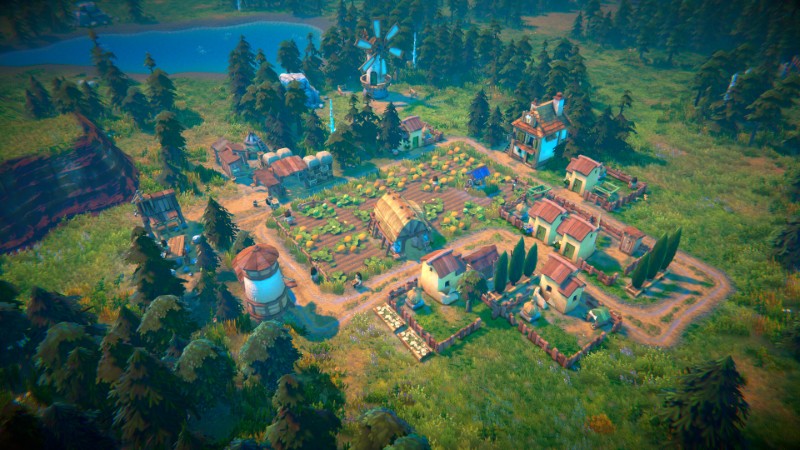
Steam | City builder | 110 mins
I love city builders but there are so many of them that trying to justify buying one over the other is more overwhelming than handling traffic in Cities: Skyline. Fabledom manages to reel me in with a refreshingly low-stakes setting without the hardcore survival elements or complex supply-chain management so central to similar games. It’s whimsical and full of fairy tale charm, though I hope it will add more convenient means of moving structures and reorganizing storage. As a child, I would have found Fabledom childish. At 31, it’s just what I need to relax after a day of work.
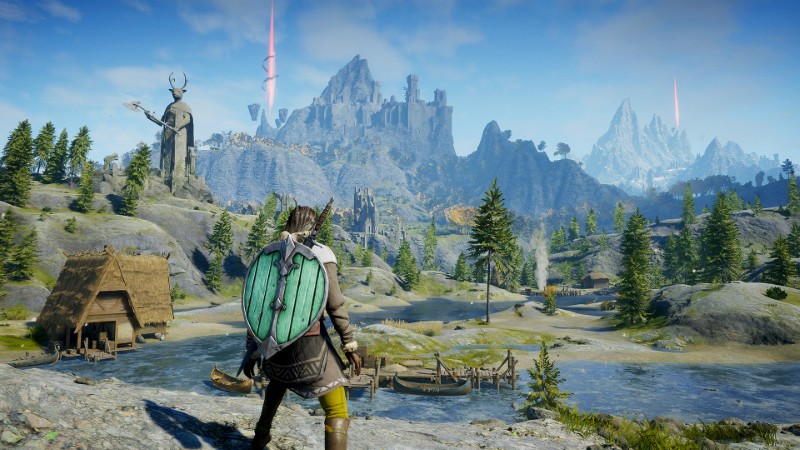
Steam | Open-world action roguelite | 68 mins
In Ravenbound, defeating enemies rewards you with random cards. You can pick one and spend mana on it to upgrade your character, but mana itself is typically only offered as a card — one that may not even appear. That left me with a pile of upgrades I couldn’t use. Because opening cards causes the open world’s bosses and mobs to become stronger, I ultimately fell behind the power curve. However, I’m sure I could have employed a different strategy to boost my chances at success. The game runs well, the animations are fluid, and it has a lot of potential.
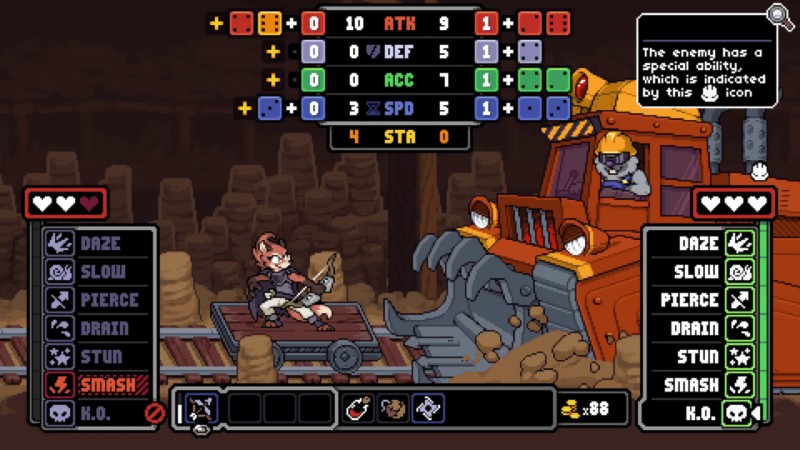
Steam | Turn-based tactics roguelite | 24 mins
Dungeons of Aether’s standout mechanic is the random dice rolls you get during each combat round. Pick a die and your opponent picks another until no dice are left, so you need to be careful about what you’re leaving on the table. Unfortunately the demo ended too quickly for me to get a proper sense of the game. I don’t know what kind of variety to expect or how the roguelite mechanics even come into play. And while I enjoyed the gameplay, the presentation isn’t my style, nor is the abundance of text so low-res as to be nearly unreadable.
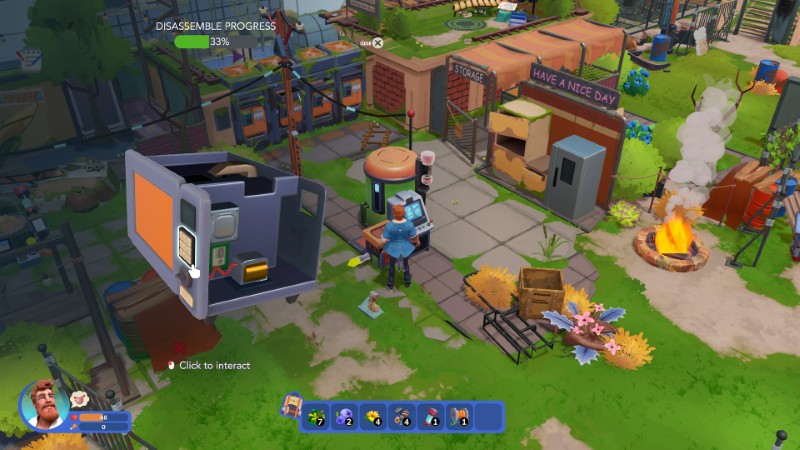
Steam | Survival crafting | 100 mins
I Am Future has an item disassembly mini-game that is genuinely fun but risks becoming tedious. That’s not good for a game that uses the traditional crafting gameplay loop: make tools, harvest materials, make better tools, harvest better materials, etc. It just doesn’t have that Stardew Valley charm or Subnautica-like mystery to keep me happily grinding. I expected a base builder on a skyscraper — yet the game has you spending far more time cleaning up scrap than building anything resembling a base. And with the constant need to stave off hunger and vermin, it hardly feels as cozy as advertised.
Steam Platform fighter roguelite | 60 mins
Spiritfall blends the tight platform fighting of Super Smash Bros with the excellent roguelite progression of Hades. You can choose different weapons for your run, upgrade abilities as you go, and unlock permanent modifiers in a main hub. Sadly, I’ve never been good at Smash combat. I just can’t seem to get the hang of aerial attacks and staying on my opponents, making flying enemies frustratingly difficult to handle. And unlike Hades, Spiritfall has little narrative appeal, thus relying solely on gameplay to keep you going. Regardless, this is a game well worth checking out for fans of either genre.
Steam | Turn-based tactics adventure | 44 mins
Highwater has lovely music, good directorial vision, and ambitions it doesn’t quite reach. It rushes to generate emotion with beautiful cinematic presentation — then undermines itself with goofy character designs, obtrusive speech bubbles, and juvenile writing. The tactics gameplay has solid bones with environmental effects, yet the main combat encounter pigeonholes you into using these effects while relying on boneheaded AI to make it work. At the end of the demo, Highwater nearly succeeds at being heartfelt — until it shows background scenery that reads “FEEEELINGS.” The demo did seem to skip around so the finished product could be more tonally consistent.
Steam | Multiplayer first-person shooter | 17 mins
I like the concept of a zero-gravity FPS enough that I added Boundary to my wishlist in 2021. I was excited to finally try the game but unfortunately, there aren’t enough players yet to consistently fill a lobby. Nonetheless, even in a half-full team deathmatch, I had fun and got to appreciate the importance of sound design. It’s tough making guns feel satisfying in the noise-swallowing void of space, yet Boundary succeeds. The 6DOF movement system also felt very intuitive to use. The biggest learning curve will be outmaneuvering opponents when there is no limit to where they can go.
Steam | Mecha turn-based tactics | 295 mins
There’s a debate about which strategy game mechanic is the best. Turn based? Real time? Real time with pause? Phantom Brigade looked at this debate and said: here, have them all. Its combat technically takes place in real time, but pauses every five seconds, effectively becoming turn based. You queue all actions for each five-second chunk using a prediction device that shows you exactly what opponents will do — enabling you to make precise adjustments and craft awesome moments. It’s totally unclear who your mechs are even fighting down there, but it doesn’t matter. Every round culminates in carefully orchestrated satisfaction.
Steam | Spaceship looter shooter | 129 mins
For the past two years, I’ve been unsuccessfully chasing the high of my first experience flying a spaceship, in VR, with a joystick in hand and a throttle in the other. EVERSPACE isn’t the game to do it. For one, it doesn’t have VR support — and it’s an arcade game better experienced with a controller. But it’s still a blast. It looks and runs very well, combat is fast and fun, there’s a solid progression system, and I felt motivated to go exploring. I only stopped the demo because 1.0 will wipe saves and I plan to play this game.
Steam | Turn-based tactics roguelite | 121 mins
Turn-based games that rely on precise strategies need to be very good at communicating to the player exactly what is happening. That’s doubly true of roguelikes that send you back to square one when you die. Inkbound puzzled me at first but once I got my head around the interface, everything made sense, and I had a really good time maneuvering around enemies and blowing them up. Inkbound is like Hades for people who have no mechanical skill — with optional multiplayer on top, which I’m excited about. I’m not so excited about it already having seasons and cosmetics before release.
Steam | Detective immersive sim | 126 mins
Shadows of Doubt is a sandbox detective game set in a 1980s cyberpunk city where everything is randomly generated, including fully simulated citizens and the crimes they get up to. You can interact with everything and make your best Charlie Kelly impression as you build a massive evidence board of clues. Some leads are dead ends and some uncover completely different mysteries. Procedural games need strong variation in how they generate content and I saw evidence of repetition. Still, I was bummed that my demo time ran out because despite getting barely anywhere, I was having a lot of fun.

Steam | Factory automation sim | 75 mins
Trying Plan B was an attempt at taking another crack at the automation genre, which I’ve never been able to enjoy. Once again, I came away feeling I’d be better off plugging numbers in a spreadsheet long before creating an automation chain in the game. Yes, it can be satisfying to see it come together — if my perfectionism didn’t compel me to spend far more time optimizing than necessary, then realize too late that I haven’t had any fun. While Plan B’s promise of terraforming a dynamically simulated world is compelling, the demo stopped long before giving me a taste.
Steam | Dice deck-building roguelite | 59 mins
Astrea is yet another game that attempts emulating Slay the Spire — with dice instead of cards. Each time you draw one, you roll for a side. The developers must recognize this could create too much variance because they grant generous rerolls and many dice simply have 50/50 odds between two abilities. My favorite feature is that class skills are usable whenever you cross HP thresholds, rewarding you for using health as a resource. I wish I’d spent more time in combat, as Astrea often occupies you with other things. Fortunately the game is very pretty no matter what you’re doing.
Steam | Hockey game roguelite | 54 mins
Tape to Tape is a hokey hockey game that makes a hilarious caricature of the sport, giving your players abilities like redirecting the puck off an opponent’s head while knocking them out. Winning is an uphill battle: the final team you face is comprised of players who are faster and more accurate than yours — and also happen to be refs. Fortunately, losing grants you the opportunity to unlock upgrades and real-life-inspired superstars, giving you a better shot next time. The singleplayer gameplay loop isn’t that captivating once the humor wears off, but multiplayer should give this game some staying power.
Steam | PvPvE extraction “shooter” | 23 mins
Dark and Darker is actually the first demo I played but I’d put it down after just eight bad minutes. Later, I decided to give it another shot. I’m glad I did because now I know my first impression wasn’t a fluke. The game joins the increasingly popular extraction shooter genre, but for once, isn’t a shooter. Sadly, making a good sword-and-sorcery combat system is not easy, and Dark and Darker shows it. It touts a hard difficulty curve, but it wouldn’t be as difficult — or as frustrating to take on the challenge — if every brawl wasn’t a clunky mess.
The genre of the moment seems to be roguelikes. They’re probably overrepresented in indie games, which make up the majority of these demos, but I’m not complaining. There wasn’t a single roguelike game I played that left me feeling like it would have been better off using a different progression system. Trying out demos was also more fun than anticipated. I learned more about my likes and dislikes, and it was nice to experience many different games without spending money — or to play them without hoping they justified the expense. Some games were forgettable, but plenty left me wanting more.
Of karma’s existence I still have doubt
As so much of the world works well without
But let us say, for I feel whimsical,
Karma is true as all things physical
As real as stars across the night arrayed
That our debt in life in the next is paid—
Then I must have been a man wholly fine
To earn in this time a love so divine.
Supply-chain issues are continuing to impact new car availability and pushing prices up, but most new-car shoppers are still willing to dig deep to get the car they want.
A new survey of 3,361 respondents in August 2022 showed that on average, nearly 39% of car owners in the United States were not driving the car they wanted — and that to get the one they did want, they would be willing to pay nearly 37% over the manufacturer suggested retail price.
This corresponds with other findings that Americans are consistently buying vehicles over MSRP. According to Kelley Blue Book, September marked a record 16th straight month that new vehicle average transaction prices were higher than recommended. The average price paid for a new car is quickly approaching $50,000. Ten years ago, it was in the low $30,000s.
For the majority of 2022, the average price of a new car was about 10% over the sticker price, with some of the more popular models going almost as high as 25% over what the manufacturer recommended — despite that this recommendation has also been steadily climbing over the years.
And yet, in Idaho, respondents said they’d be willing to pay even more to get the car they want: as much as 71% over the asking price. And while residents of other states were less prone to overspending (North and South Dakota, West Virginia, and Rhode Island were the lowest at 11%), the overall U.S.-wide average of 37% shows that dealerships still have margin to extract more dollars out of customers faced with limited availability of the cars they want.
However, there are signs that cars are finally coming back in stock and consumers are attempting to save rather than spend as inflation continues to rise and the threat of a recession looms. Additionally, automakers like GM, Ford, Hyundai, and Kia have warned they may take punitive measures against dealers applying high markups.
Unfortunately, even if car prices go down, record-high interest rates may offset the advantage. For the time being, unless you absolutely need a new ride, it’s best to sit tight. But you probably won’t.
If you do a lot of automotive research like I do for work, something becomes clear very quickly: brands love to flaunt the awards they win — and boy, do they win a lot of awards. But because there are so many available awards, it becomes almost impossible for brands or individual models to fail to get one eventually, and they quickly become meaningless.
Let’s look at some of the ways a car might succeed in being represented in a publication’s latest list of the top vehicles. First, it’s typically an annual thing, so even if they miss out this year, there’s always the next. Second, the awards are often divided into automotive segments — after all, it doesn’t make sense to pit a Porsche 911 against a Chrysler Pacifica when they both try to achieve very different things. Nonetheless, as a result of this separation, the number of awards up for grabs goes up significantly.
Additionally, many award lists are just that: lists. They’re not content with telling you the best full-size pickup truck on the market today. Instead, why don’t you have the top three…or five? Forget for a moment that this particular segment includes only eight vehicles in total, which means there will be more vehicles on it than not. Indeed, many of these lists are not short. The point, after all, isn’t to help readers find the top vehicles. It’s to rank on Google searches.
Seven-passenger SUVs are not that common either, yet you can find many award lists that include the top 10 or even 12. Then there are specific awards such as those for cars under a certain price, or those best suited to teens, families, off-road adventurers, dog lovers, or even buyers seeking the top green winter vehicle. At the end of the day, publications can and do come up with so many unique categories that just about every car can be represented somehow, somewhere.
What’s more, the number of outlets that publish award lists rivals the number of car nameplates, and many undoubtedly come up with a variety of niche award categories in the hopes of getting your clicks. And the more vehicles they feature, the more likely it is that the manufacturer sends web traffic back to the publication via the celebratory press release they inevitably put out.
Sure, some awards rank more than others. For example, it’s always a good thing to learn a vehicle has earned an IIHS Top Safety Pick+ award. But next time an automaker flaunts its latest obscure “honor” or “recognition,” consider for a moment if it really means anything at all.
Out of vines and tangled brush
He finds a clearing between mushroom and bush
Before he can catch his breath
A little oriole lands on hand outstretched.
The world freezes, caught in time.
It chirps and cocks its head, bright-eyed, feathers fine
A thin ray of warm sunshine
Unveils rich orange and resplendent eyes brown
While across those wings slender
Pretty white patches form the fairest picture.
The man yearns to admire
Endeavoring to stay still as a whisper—
But the moment is soon past
White-patched wings lift and flutter
Ready to catch on a long-awaited draft.
Dazed by grief and desire
He senses outstretched fingers start to shudder
Why not grab the oriole?
Take it home, feed it, and by hearth keep it warm?
Would it not be preferable
To love and shelter a life so valuable?
An age lives in this moment
Till at last the black bird soars from hand open.
What could he do but observe
When freedom was all that made it so superb?
His heart swells as he sees it go
Tangled vines now memories from long ago,
In their place this arrival.
A beautiful, unexpected oriole.
Nearly all competitive multiplayer video games that feature strategic elements develop what gamers call “the meta,” a set of theories about the best way to play. For example, in a team-based game with finite resources like League of Legends, the optimal distribution of those resources becomes part of the meta. In the card game Gwent, the strongest decks and how to play against them define the meta.
Metas add an interesting layer to gaming because they continually evolve alongside player knowledge and game updates. On the internet, millions of gamers discuss and hone meta strategies. Widespread coaching tools and advanced analytics help them improve their skills at an unprecedented rate. But because the ultimate goal of any given meta is to help players win more games, it can also obstruct potential avenues of enjoyment. After all, winning is just one reason people play.
Mark Rosewater, head designer of Magic: The Gathering, once wrote about Timmy, Johnny, and Spike — caricatures of the three most common types of players. Timmy likes flashy plays. Johnny wants to express himself. And Spike enjoys winning above all. Players are rarely so one-dimensional and the original example was in the context of a card game, but the concepts have widespread relevance.
Though Spike takes winning more seriously, Timmy and Johnny also like to win. But as metas develop, suboptimal strategies become less viable. Low-performing players who, without the aid of the internet, may once have provided Johnny’s homebrew strategies the opportunity to succeed, are instead lifted by the meta into relative competence. Metas make it increasingly difficult for players to win if they don’t make winning their top priority.
Metas also create toxic environments. As optimal strategies spread in the collective consciousness of a game’s playerbase, they become the unofficially accepted way to play. Players often enforce the meta upon their teammates — sometimes without knowing why. To them, it’s just how things are done. Metas are thus hostile to unfamiliar new players and to those who attempt to play in their own way; while to meta-abiding players, non-meta strategies represent a risk to their chance of success at best and intentional sabotage at worst. Either side may find the other toxic.
Players still routinely find ways to succeed outside of metas — but in team games, the longer a meta has been established, the lower the tolerance for originality. Player-defined metas can become so pervasive that developers may incorporate them directly into their games. Metas that appeal to spectators can steer the direction of game updates as developers seek to boost esports viewership. When Blizzard Entertainment failed to balance the first-person shooter Overwatch so that professional teams comprised of two tank, two DPS, and two support players would become the meta, it simply made it a rule.
Metas have been around since even before video games and have always existed to serve players like Spike. But thanks to the internet, metas grow, spread, and become established more quickly than ever — leaving Timmy and especially Johnny far behind.
Some bad driver habits are so common that they stop being irritating and instead barely penetrate one’s consciousness. When you’ve seen hundreds of drivers block the left lane on the highway before, what’s another? Still, there’s nothing like a little rant now and then. And who knows, you might discover you have one of the habits described below. (If you do, please stop. Thanks.)
On U.S. highways, the left lane is so commonly called “the fast lane” that many Americans mistakenly view it as a place to hang out if they subjectively feel they are going fast enough. Others simply stick to the speed limit and intentionally act like a road block for other drivers, satisfied in doing the police’s job. Either way, it’s rude and, in some states, illegal.
That’s because the leftmost lane is for passing, and passing only. Once you’ve passed a car, you should get back to the middle lane. And then into the rightmost lane if it’s empty, because you should always be driving as far right as possible and moving left only to pass. Too many people merge onto the highway and immediately move over to the middle or all the way to the left for no reason whatsoever. So, repeat after me: If you are getting passed on the right, you’re in the wrong lane.
If you have the right of way but want to stop in the middle of your lane to make room for a car who is clearly going to have to wait a while before they can join or cross the road — just don’t. Courtesy is nice, but it’s not worth making yourself unpredictable. The roads are safer when everyone adheres to the same traffic rules. It’s also very likely that by saving one person a little time, you create a traffic jam behind you.
Driving a 4,000-pound vehicle made of steel, aluminum, and hardened plastic can be understandably scary. But you shouldn’t be afraid of using your car’s go-fast pedal. The most important thing you can do when getting on the highway, or merging onto any road, is to drive at the same speed as the cars already there. If you merge too slowly, you’re going to have a hard time getting on and you’re liable to create an accident or a traffic jam. And if you’re merging off, don’t slow down while you’re still on the highway. That’s what the off-ramp is for.
We’ve probably all had to bail out of a turn or lay on our horn when a driver in the outside lane seemed to forget that another car had been alongside them the whole time. It’s especially scary if they happen to be driving a big vehicle. How does this happen? It’s a mystery. One would think that after stopping at a traffic light next to someone else, one would simply understand that the other driver would also be going ahead when the light goes green. Could folks stay in their lane, please?
This post contains spoilers.
Genre: Science-fiction film
In Blade Runner 2049, K is a replicant — an android virtually indistinguishable from humans — who discovers his implanted memories are real, and begins to believe he may have been born rather than manufactured. This is an inversion of the original film, in which the true nature of Rick Deckard — who believes himself to be human — is left ambiguous.
Following a long, emotional search for his literal humanity, K learns he is only a replicant after all. The Chosen One trope is thus turned on its head and for K, it’s a crushing letdown — one that can also be difficult for the audience because BR2049 takes such great care to humanize the character.
Indeed, when K begins to believes he might actually be human, it’s easy for us to go along despite evidence to the contrary. K can read a million words a minute, perceive microscopic details, and withstand (as well as inflict) tremendous amounts of physical punishment. How could one see him as anything but a machine? Yet K is utterly, convincingly human.
Outside of those physical abilities, there’s truly little to differentiate him from anyone else. He eats, sleeps, and works for a wage. He lives among people. He bleeds. He struggles. He cherishes his memories and shares them in private. He longs for companionship and nurtures the only relationship he has, however artificial. During his journey of self-discovery, his gradual loss of emotional control — culminating into something like a full-blown breakdown — only serves to humanize him further.
From the beginning, K’s rich human experience seems to support his possibly unique origins. Even before he has any reason to believe he could have been born, K displays a plethora of human traits in BR2049’s wonderfully crafted opening scene: He falls asleep in transit, a small yet relatable thing; he shows respect for Sapper Morton’s property, even though Morton is a replicant he has been tasked to retire; and he displays genuine curiosity about Morton’s cooking before imploring him to cooperate, hoping to avoid the “hard part of the day” that clearly make him queasy.
Joi also hints that K has long engaged in self-contemplation prior to that encounter. And who hasn’t? The movie’s initial revelation — that a replicant has given birth — is likely little more than the catalyst for K’s long-brewing existential crisis, one driven by his very human need to be special. Having so dearly desired to be human, he leaps at the chance to confirm that reality. And when it crashes down upon him like a hurricane, his distress and ensuing depressive state once again only make him seem more human.
It’s all too easy for the audience to deceive itself, along with K, into believing he is. Indeed, faced with someone whose experiences are so incredibly human, how could one perceive K as anything less? And in the end, does it really matter that he’s not? The revelation that he isn’t human only crystallizes that he never needed to be. Like Roy Batty before him, he’s already “more human than human.”
“Big engine go fast.”
Chevrolet’s press release about the new ZZ632 crate engine contained a lot of words and numbers, but it could have been condensed to just that single sentence. Yes, the engine is so ridiculously large and powerful that it has transported my brain back in time to a pre-adult state, to those blissful days when sentence structure didn’t matter. Which doesn’t make any sense, because this is a big boy engine.
So let’s get the numbers out of the way. The first is 632 cubic inches, also known as 10.3 liters of displacement. Scratch what I said earlier — we’re not even in big boy territory anymore. This is more like Godzilla territory. Wait, no, the Nissan GT-R already has that analogy claimed. Maybe Shai-Hulud? Oh yeah, that’s the one. Dune was great.
Anyway, I’m getting side-tracked here. Can you blame me? My head’s still spinning from the size of this thing. (I might also be in love with Denis Villeneuve). With over 10 liters of displacement comes a suitably high number of horsepowers and torques: 1,004 at 6,600 RPM and 876 lb-ft at 5,600 RPM, respectively. Just floor that baby and enjoy the hand of god giving you mighty shove in the back. Or, if you choose to plant that massive engine at the front of your ride, a nice tug. Mmm baby.
Chevrolet “recommends” not going over 7,000 revs and it’s not entirely clear what that means. If that’s the rev limit, why not just call it that? What happens if you try to go beyond 7,000 RPM? Will the ZZ632 crate engine go nuclear? Will it cause you to go so fast as to break the laws of physics? Has Chevrolet brought forth an engine capable of bridging space and time? Oh god, here I go talking about Dune again.
“This is the biggest, baddest crate engine we’ve ever built,” said Russ O’Blenes, director of massive engines and fast cars at General Motors. “The ZZ632 sits at the top of our unparalleled crate engine lineup as the king of performance.”
Thanks O’Blenes, that’s valuable information. But can you tell us something we don’t already know?
“It delivers incredible power, and it does it on pump gas.”
Oh my. Turns out melange isn’t necessary for going warp speed — all you need is a bit of 93 octane. Of course, the parallel between oil and spice was kind of the whole point of Frank Herbert’s epic novel. And now there’s a 1,004-horsepower crate engine that can help you get to the nearest IMAX theater even faster.
This review contains spoilers for the first 30 minutes of the game.
Genre: Adventure video game (sandbox, first-person)
Outer Wilds begins with your character waking from a nap by a campfire. As you slowly open your eyes, you notice a light, far above in space, streaking across the void. If you want, you can travel there and investigate. It turns out you’re an astronaut and today is your big day.
You get used to seeing that streaking light.
In the first thirty minutes of the game, you learn that only a handful of pioneers have ventured into space before you. Unlike them, you are equipped with the first tool capable of translating texts left behind by the Nomai, an ancient civilization.
Armed with this translator, you get into a rickety spaceship, take off, and set out in any direction you wish. The game’s solar system is tiny compared to the endless emptiness of real space, but nonetheless large enough that finding purpose can initially feel overwhelming.
The Attlerock, a nearby moon with a huge crater, could be a good place to explore. But as you wander, perhaps unsure of what to do, the sun explodes. Everything dies, you included. Then — you wake from a nap by a campfire. You slowly open your eyes and far above, a light streaks across space.
Was it a dream? Did you somehow survive a supernova? Are you in a time loop? Will the sun collapse again? Needless to say, your death leaves you with a lot of questions. Fortunately, the outer wilds have answers — and from the very start, the game equips you with all the tools you need to get them.
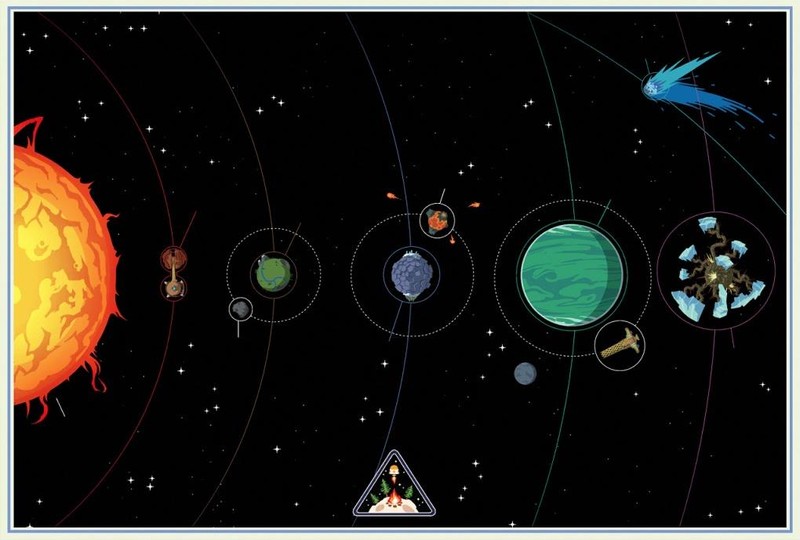
Unlike many video games, there are no gated areas in Outer Wilds unlocked only after meeting a prerequisite. There are no quests. No items to upgrade nor skills to enhance. No combat. At your disposal are a ship, spacesuit, translator, signal scanner, camera, and flashlight. With these tools, you can get anywhere and answer any question. You just need to explore the solar system and do a little digging.
Curiosity thus drives everything you do in Outer Wilds. As long as you have a question, you have a purpose; and the hunt for answers slowly reveals an intricate story full of wonderful eureka moments. Space exploration is brutally dangerous and there are many ways to die in the game, but because player knowledge — not character knowledge — is the only thing to gain, no virtual demise can erase your progress. A puzzle hides beneath the hostile sandbox of space, and little by little, you begin to see the shapes. Death is just part of the process.
Indeed, you may die countless times in Outer Wilds — yet, incredibly, you never actually need to. With the right knowledge, you can wake from that first nap and experience the intended ending in under half an hour. But to acquire that knowledge, you must first go through a masterclass in player exploration and discovery, one that ultimately drives you toward an emotionally touching conclusion. Even without that final reward, the journey is worth every moment.
This review contains spoilers.
Genre: Survival drama TV show
Capitalist rhetoric claims competition, free markets, and hard work are all it take to make a fortune fair and square, and that those left behind have only themselves to blame. In gory detail, Squid Game explores the cost of that competition and shows how, no matter one’s personal character, acquiring wealth in a capitalist system is necessarily unethical.
The organizers of the game make its participants a promise: Unlike in the real world, where they have little chance of getting out from under capitalism’s crushing boot, they each have an equal opportunity to win. At first, the promise seems genuine. When a player is caught cheating, the game overseer executes him and his abettors without a second thought. And the first game they play — “Red Light, Green Light” — has a pretty fair set of rules.
But the pretense of fairness breaks down quickly. Players had not been told they would be brutally murdered should they lose. And it’s only when the survivors express the desire to leave that the prize is literally dangled above their heads, its message clear and vicious: the more people die, the more money you stand to win.
The game’s creator absolves himself of responsibility, noting the participants agreed to the terms. He conveniently ignores that as a money-lender, he is guilty of contributing to the pressures that led players to accept the terms in the first place — and that his recruiters leveraged the hopeless circumstances he created to convince them to join.
By the time players get to the bridge game, it’s overly clear the entire endeavor is not, as advertised, a respite from the capitalist system, but rather a microcosm of it. The only way to win is by making the right connections, ruthlessly eliminating and backstabbing the competition, and getting extremely lucky.
In the end, the last man standing is neither the savviest nor the most able individual. He could have been any one of the others who died. And his reward, a glowing pot of money, has come at the cost of hundreds of lives and his own humanity. What were the alternatives? To die or not participate at all — the latter an arguably worse fate as shown in the only episode, entitled “Hell,” that takes place entirely outside the games. In real life, though, not participating in capitalism is rarely an option.
In Squid Game, like in Parasite, the lower class fight each other for the scraps of the rich, who got rich by profiting off of them. The system is purported to be fair, but has perverse incentives and primarily rewards luck and exploitative behaviors. To merely fight for one’s survival is to actively participate in the demise of others.
Even though the winner was arguably the nicest person involved, he understands despairing at the blood spilled in the name of survival does not wash his hands clean of it. Consequently, he can’t bring himself to use the money. Spending it would be tantamount to spending those lives once more.
This review contains spoilers about the show’s themes, but no plot spoilers.
Genre: Crime drama TV show (five seasons, 60 episodes)
When The Wire first aired, it didn’t really rate. It won no awards, the viewership was nothing to write home about, and the critical response was good but not phenomenal. Yet today, almost every list of the greatest TV shows of all time feature The Wire somewhere in the top five. Why?
Many of its qualities are timeless. Its portrayal of police work, poverty and drug culture, education, and local government is not only totally honest and unpretentious, but also deeply human. It has a talented ensemble cast of actors who accurately represent Baltimore demographics. And then there’s The Bunk and all of his memorable zingers.
But The Wire is more than just a cops-and-criminals show. Over five seasons, it explores how institutions betray the people they’re meant to serve and the impossible challenges faced by those wishing to do something meaningfully good within those institutions. It’s an unusually realistic look at hopeless circumstances many Americans will find all too familiar.
Though the Baltimore Police Department takes center stage, it’s not the only star of the show. The department’s stories are part of an impressively consistent and well-written narrative thread that runs through all five seasons, weaving itself through those of other important institutions: the port union, the school system, the media, the courts, and of course, the criminal organizations.
Their parallels are ever transparent. Gangs share eerily similar hierarchies as the legal administrations tasked with taking them down — and are often, through backdoor handshakes and laundered money, more connected than it would seem.
And just as street-level thugs “stand tall,” silently eating charges to protect so-called friends whose loyalties end as soon as it is convenient, so too must corrupt politicians stand tall to avoid exposing their fellow white-collar criminals. There’s no such thing as a corrupt person in power working alone. Everyone’s got a hand in somebody’s pocket.
For all the small victories and feel-good moments peppered throughout its 60 episodes, The Wire ends on a bleak note. Its final message is unambiguous: nothing really changes. There are simply too many cogs in the machine, too many perverse incentives, and too many conflicting interests pulling in all directions.
If you have good intentions, institutions will grind you down until you choose to leave, are made to leave, or have nothing left of your former, optimistic self. The only way to get in a position to enact real change is to make so many deals and compromises that, by the time you’ve finally gotten into that position, you’ve essentially traded all its power away.
Almost two decades after The Wire first aired, Americans have long lost any trust that institutions have got their backs. Society is reaching all-time high levels of apathy and cynicism. More than check all the boxes that make good television, The Wire resonates powerfully. Let us hope it eventually falls down the ranks in those greatest TV show lists, not because newer and better ones are released, but because it stops being so goddamn real.
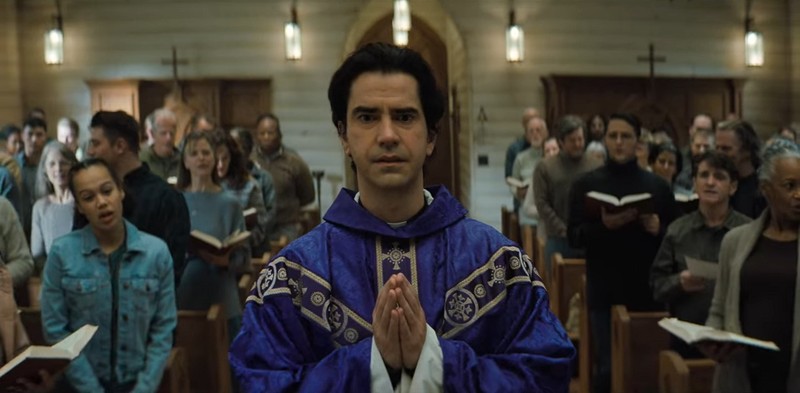
This review contains spoilers.
Genre: Supernatural horror miniseries
Midnight Mass is a series about guilt, grief, and a blood-sucking vampire. It’s about the struggle to reclaim one’s life after addiction has taken it over — whether that addiction is to alcohol, blood, or even self-pity; and about the strange, barely disguised cannibalistic undertones of Communion.
It’s also a meditation on the ways religion can pit people against each other just as easily as it can unite them. How scripture can be wielded against the faithful, by both good and bad actors, to justify almost anything.
When Monsignor Pruitt first encounters a vampire, it attacks him and drinks his blood. After initially leaving him for dead, it changes its mind and feeds Pruitt its own blood. Because this has the side-effect of bringing the old man back to the prime of his life, he concludes the vampire is actually an angel. Already, Pruitt’s need to fit experiences within the framework of his faith causes him to ignore several glaring problems.
Hoping to spread this gift of rejuvenation, Pruitt brings the “angel” to his hometown on Crockett Island. He then inadvertently dies and comes back to life as a vampire himself, cursed by skin that burns in sunlight and a vicious thirst for blood. Despite these alarming symptoms, he doubles down on his plan to spread the condition to everyone on the island.
A central theme of Midnight Mass is how faith can be hijacked to enable otherwise well-meaning people to engage in this type of questionable behavior. With the backing of scripture, Pruitt convinces himself and the faithful of Crockett Island to go along with an increasingly gruesome plot. Religion is shown to be vulnerable to becoming a vessel for horror, whether unintentionally (as demonstrated by Pruitt) or intentionally (by Beverly Keane).
The rejuvenating vampire blood is used to create apparent miracles. Biblical passages describing the fear angels inspired in those they visited seem to conveniently explain the vampire’s terrifying appearance. And when Pruitt experiences mindless bloodlust for the first time, he decides God must have taken control of his body. It’s easier to deceive oneself than to look upon the face of hard truth.
Among the few who do not fall prey to this Catholic self-deception are, unsurprisingly, a skeptic, a scientist, and a Muslim. The temptation to find comfortable explanations that avoid challenging an easily-held belief is something we all know. Exercised well, skepticism and scientific inquiry can be tools for fighting that temptation.
But when the risk is not just to a single belief but to one’s entire understanding of reality, the mind can grasp at anything it finds to protect itself. Faith cannot allow doubt to creep in and take hold, because that doubt risks becoming the hammer that shatters the whole thing. Instead, it can only double down on itself — more faith, rewarding itself for furious belief in the unbelievable. The alternative, for those who have only ever had faith to lean upon, is like a void, too dreadfully absent of answers to even contemplate.
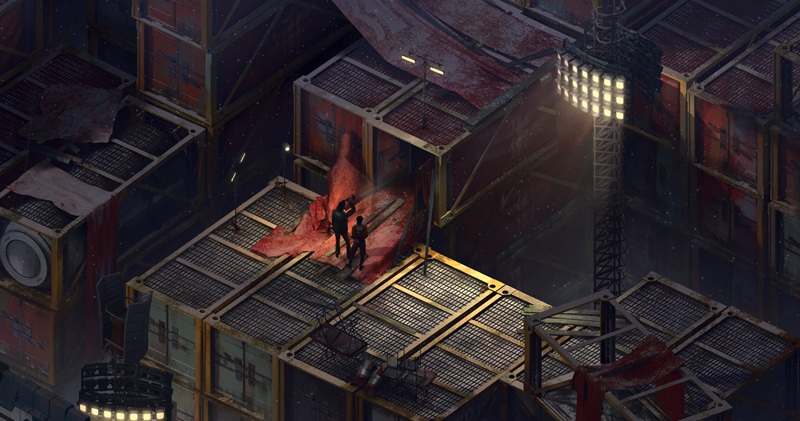
This review includes very light spoilers for the start of the game.
Genre: Detective role-playing video game (open world, isometric)
In Disco Elysium, you spend just as much time talking to yourself as with other characters. That’s because the skills you can level — such as Conceptualization, Volition, and Reaction Speed — are constantly pitching in with ideas about what you’re seeing and what you should do.
For example, investing in Encyclopedia turns your character into a trivia machine, able to conjure up random knowledge about obscure subjects brought up in conversation. This typically starts as an inner thought, which you can then choose to share out loud — it might be helpful, but it’s just as likely to come across as aggressive ADHD to other characters.
Most of the skills in Disco Elysium work this way. A wide cast of mental and physical impulses add unique flavor to everything you do — with both positive and negative consequences. Putting points in Drama can help you detect if somebody is lying, but investing a lot of points in Drama can turn you into a compulsive liar convinced that every word you hear is dripping with deceit.
Your inner thoughts also contradict each other. Logic may suggest an action that Empathy immediately shoots down. Physical Instrument, the skill concerned with musculature and organ health, isn’t always pleased that Electro-Chemistry routinely urges you to take psychedelics.
There are countless ways for your skills to interact, which all depend on how you invest your skill points and the choices you make in the world. This makes the game deliciously replayable even if you’ve already absorbed the enormous quantity of narrative content it has to offer.
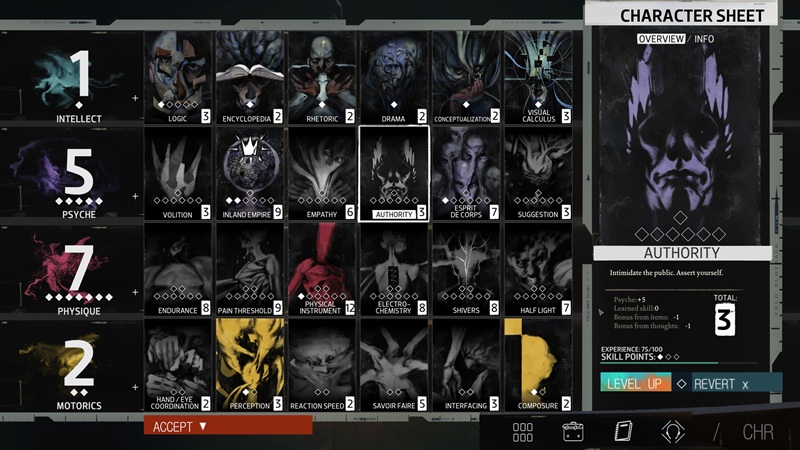
Wonderfully, the game doesn’t punish you for taking the inner dialog system all the way to truly outlandish extremes. As a loading screen helpfully suggests, you shouldn’t be afraid to make strange choices, because people are less likely to question authority figures such as yourself. You can get away with genuinely absurd shit.
This can seem at odds with the game’s generally serious tone and excellent writing, but the latter is exactly why it works, and that juxtaposition — the insane detective taking on a serious murder mystery — makes for a very entertaining experience, including when it causes you to succeed, or fail, in spectacular fashion.
For example, at the start of the game, your low-level skills — combined with an apocalyptic hangover that has left you very vulnerable — can comically let you down. In the very first room where Disco Elysium begins, it’s possible to toggle the light too many times and give yourself a heart attack, thus ending the game on the spot. Moments later, you can fall on your face and die while attempting to punch a kid.
Eventually, though your actions continue to have consequences, they’re fortunately less likely to outright kill you. The game does a beautiful job of letting you be whoever you want — whether that’s a snobby Art Cop, a proselytizing Communist Cop, a Disco Cop on the hunt for the sickest beat in town, or something more sinister.
In short: a masterpiece.
There is so much to criticize about the eighth and final season of Game of Thrones that after writing that long tirade about S8E03, “The Long Night,” I decided there was no point in making further posts about the remaining episodes, as their flaws would already be well explored by just about the entirety of the internet.
And indeed, the eighth season has already been pored over and meticulously picked apart to such a huge extent in the last few weeks that adding yet another rant about the whole thing seems like a waste of energy. However, I had begun writing this post the day after the finale and I’m not about to delete it, so I decided to limit it to addressing just one of my main gripes about S8E06, “The Iron Throne”: Jon’s fate.
Most Game of Thrones fans will have heard the claim that George R. R. Martin intended for the series ending to be “bittersweet.” Though the finale lacks just about anything sweet, I would not be surprised if Jon’s fate in the books is indeed planned to be about as bitter as in the show — with the crucial exception that it would be more understandable to the readers than it was to the viewers.
I think that by the end of the series, Jon is meant to be a broken man, or at least a very tired and disillusioned one. He fulfills the Azor Ahai prophecy that has him plunging his sword into the heart of the woman he loves to save the world, but the act of doing so shatters him. Exile, if self-imposed, would make some sense here.
Jon has obstinately toiled and self-sacrificed since the start of his story, even literally dying for a cause he believed in. He’s been in the thick of constant violence and death, and he’s tragically lost both of the women he has loved. It would not be surprising if, faced with a choice, he would want to finally have some peace away from all the war and the politics. He’s the Prince That Was Promised, not the king to be.
Unfortunately, not only does the show rob him of that choice for unbelievable reasons, it also makes no effort to make us understand his mindset. The love between Dany and Jon is poorly established, and the actors’ on-screen chemistry is lacking — it’s light years removed from the relationship between Ygritte and Jon earlier in the series. As a result, when Jon kills Dany, we don’t feel the full impact it should have on him.
The only indication we get of Jon’s inner turmoil is that he looks sullen all of the time. But this isn’t exactly a revelation: He’s been like that during most of the season even at the supposed height of his love with Dany; he is already known for brooding (Tyrion makes a dumb fan-service meta joke about this in Season 7); and crucially, Kit Harrington’s performance isn’t any different before and after he kills Dany.
Before the act his demeanor is largely muted, and after the act it follows the same pattern in the little screen time he gets. I understand that Jon was supposed to be in growing denial about who Dany reveals herself to be (leading to a confusing scene with Tyrion in which he leads by saying he won’t even try to defend her attack on King’s Landing, only to then immediately defend it), but throughout Season 8 as a whole Jon seems to have been completely sapped of any life and personality, though the latter can be applied to most of the franchise’s characters.
Presumably, before Jon kills Dany he is brooding because he feels conflicted about their relationship, then he is brooding because he is in denial of her increasing “madness,” then he is brooding because he knows he has to kill her, and finally he is brooding because he has killed her. All of this coming from a character who is generally broody to begin with. This means that outwardly, it’s difficult to grasp Jon’s emotional progression; how we started with someone who was King in the North and had a claim to the Iron Throne, to someone who would want to go into exile. Worse, we get absolutely no insight into what Jon thinks or believes after he kills Dany.
If Jon had merely been presented with a choice, it would have been an opportunity to show Jon’s mindset and motivations after fulfilling the Azor Ahai prophecy. But apparently, setting up Jon to choose exile and doing so in a way consistent with his character was a pointless endeavor from the perspective of writers David Benioff and D. B. Weiss, who instead came up with a bewildering alternative: Make him take the black. Send him back to the Night’s Watch and thus force him into exile instead.
Not only does this rob us of a good potential character moment, it makes absolutely no sense. What Night’s Watch? The men of the Night’s Watch are dead, the Wall is broken, and there’s nothing left to watch but the snow. Even the writers don’t seem to believe in their own excuse to send Jon away, because he never takes the black anyway.
Instead, he goes straight beyond the Wall with the wildlings, which is also confusing. We spent seasons establishing that the wildlings want to come south of the wall, not just because of the Others but also because — surprise — living in a tundra sucks. Jon had even offered them lands when he convinced them to come to the Wall with him. Why in the world would they all go straight back beyond the Wall?
And finally, why would Jon have to go into forced exile in the first place? The only people who wanted him punished were the Unsullied — a small group of people who should be in no position to make demands. Not only are they the remainders of a tyrant’s army, they leave to Naath right away, presumably never to return. Is there anyone left in Westeros who wouldn’t want Jon around?
The man killed a mass murderer who he loved for the sake of the people. He should be hailed as a hero. There’s quite literally no reason he should be forced to take the black. Self-exile would have made some sense, but instead we got this rubbish.
This is all on top of the fact that Jon is still the rightful heir to the throne, which apparently no longer means anything because, supposedly, the “wheel” has been broken, even though it’s painfully obvious it really hasn’t been. But now I’m getting into other issues about the episode and the series, and I’ll just stop there.
I love the way Game of Thrones S8E3 begins. Titled “The Long Night,” it’s suitably dark, there’s an unseen army of undead somewhere in the distance, and Samwell Tarly looks like he’s pissing himself in fear, not unlike how I feel about the potential death of the many major characters who are facing this threat, now surely devoid of plot armor as the series comes to a close.
Then Melisandre appears, sets all of the Dothraki swords aflame, and they ride off into the dark unknown. It looks spectacular. I’m especially fond of the shot of the fiery boulders streaking above the Dothraki across the black sky, and the way all of their lights slowly go out. Only a few stragglers return, including Jorah, and the wights finally do their own bit of charging — and it’s utterly terrifying.
But while the charge is visually stunning (like the dragons flying above the cloud cover), it makes no tactical sense whatsoever. Why send the calvary ahead alone, with no support? It’s a suicide mission. Their mobility should be used to attack from the flanks. One could argue that the Dothraki, not exactly known for their orderly combat style, and spurred on by their new flaming swords, simply charge ahead regardless of any preconceived plans, but we get no reaction shots or lines to indicate this is the case.
Evidently, the Dothraki charge is an attempt at the Rule of Cool, a common film trope that involves showing something that makes little sense, but which the viewers will forgive because the result is “wicked sweet or awesome.” For me, I’m not sure it quite reaches that cool-enough threshold. The shots are amazing, yes (though a little dark), but I’m not sure I can forgive such a tactical blunder when the stakes are so high, and I certainly can’t forgive whoever had the idea to put the trebuchets ahead of the infantry lines, ensuring they can only ever be used once. Was Tyrion in the crypts during the entire planning phase as well?
Still, I thought the episode was off to a decent start. The charging wights look utterly unstoppable. They don’t so much run as they become a wave of living corpses, running and crawling atop of each other as they overwhelm everything in front of them (I was briefly reminded of Ralphzilla in Ralph Breaks the Internet). Those initial moments set the dire tone for the episode in a good way, and with several major characters in the front lines, I thought for sure it would be the end for a good number of them.
But it wasn’t (except, early on, for poor Edd, a lovable but minor character). Time and time again, named characters are saved from what seems like sure death, owing their lives to other named characters or, more often, to a timely cut. I recently read Stephen King’s Misery for the first time, in which the primary antagonist Annie Wilkes complains about stories that cheat. She describes how she used to watch serials until one ended in a cliffhanger that seemed to put a character in an impossible situation. She spent a week wondering how the character would survive, only for the next episode to resume with the character in a slightly different but much less compromising situation than the one he had actually been in. Instead of providing a solution, the serial had simply cheated and Annie Wilkes couldn’t abide the sloppy writing.
Unfortunately, it’s exactly that kind of cheating that “The Long Night” frequently relies upon. Excluding the Dothraki, Greyworm is one of several named characters at the front of the group that makes first contact with the wave of wights, who violently wash over him during their assault. Yet the next time we see him he is somehow fine, away from the action and organizing the retreat. At one point Jon is literally skipping over corpses as he tries to charge the Night King, ends up surrounded by them when they are raised, but the next time we see him almost all of those wights have been diminished to a much more manageable dozen or so — who are all, for some reason, only shambling instead of running as they were doing before. At some point, he even manages to stroll back to the castle alone.
On countless occasions we briefly see Brienne, Jaime, Sam, Tormund, and other named characters in impossible situations, only for them to be fine or in a slightly different impossible situation the next time the camera cuts back to them. This is a strategy the show has already employed in previous big battles, and it goes on until the army is defeated. It’s not hard to guess why the show does this. If they put beloved characters in situations that do look manageable, we might have hope they’ll pull through. Instead, we’re supposed to think that this is it, this is the end for them. But you can only get away with letting our protagonists off the hook without a good explanation so many times, and by the middle of the episode, there had been so many cheated deaths that I eventually stopped feeling any fear that anyone important might die.
Plot armor is clearly not an issue isolated to Game of Thrones. In fact, one of the reasons the show became so popular was because it often subverted the expectation that protagonists will always survive. However, the less source material it has had to draw upon, the more the show’s heroes have seemed to get away with staying alive in the face of what, for anyone else, would amount to sure death. The show now seems to rely on the reputation it has built for not being afraid to kill off major characters to build tension, only to never actually kill them.
How the army of the dead is ultimately defeated is not satisfying, either. Of all the ways to wrap up the winter storyline, one-shotting the Night King to instantly destroy his army is one of the most cliche conclusions. This is the first battle south of the Wall between the dead and the living, and the living just win it all on their first encounter?
It’s true that the Night King’s ability to raise the dead means that any defeat for the living would make the next battle even less winnable, which is why I was a big fan of the theory that the Night King wouldn’t even be there. Rather, he would go to King’s Landing to get himself a few million wights, something our protagonists in Winterfell would only realize after winning a smaller, easier battle than they had expected. Then the true battle would come in episode 5, with the stakes higher than ever.
That is just one of many potentially interesting developments; instead we get yet another variant of the most overused battle plot of 21st century film, where the good guys seem totally overwhelmed and at the last second, the main bad guy or central network is destroyed and the entire enemy army is defeated at once. Even though they had hinted at this in previous episodes, I desperately hoped it wouldn’t come to that. But as the episode was building up to all of our characters facing imminent death at the same time, culminating with Jon facing the dragon, it seemed inevitable we were about to see something that would turn the battle on its head all at once.
Yet even then, I still didn’t expect someone would just kill the Night King. After all, that would have been too disappointing. Who would have guessed we would get eight seasons of build-up about the coming threat, only for the Night King to die outright before we have any chance to actually understand him or see him in combat?
Furthermore, it happens in an incredibly frustrating way. Arya materializes out of nowhere, having snuck past an entire army of wights and several White Walkers, and does with Valyrian Steel what Dragonfire could not, even though the former derives its potency from the latter. So not only does the army of the dead get Phantom Menaced, it happens with an unearned deus ex machina.
This is doubly disappointing because, once again, one of the reasons Game of Thrones is so successful is because it used to have a habit of undermining these kind of tropes. Take a look at this George R. R. Martin quote:
I admire Tolkien greatly. His books had enormous influence on me. And the trope that he sort of established — the idea of the Dark Lord and his Evil Minions — in the hands of lesser writers over the years and decades has not served the genre well. It has been beaten to death. The battle of good and evil is a great subject for any book and certainly for a fantasy book, but I think ultimately the battle between good and evil is weighed within the individual human heart and not necessarily between an army of people dressed in white and an army of people dressed in black. When I look at the world, I see that most real living breathing human beings are grey.
Yet ultimately, this is what we get: a dark lord and his evil minions. It’s telling that in the books, the Night King does not even exist. The undead are simply known as The Others and have no known leader. This new, mysterious threat presents titillating possibilities, and the world-building that takes place in earlier seasons seems to hint at a different motive than simply “kill all the living.” That the army of the dead is reduced to yet another trope is underwhelming to say the least. What is the point of Bran going north of the Wall? Of the Lightbringer prophecy? Of Jon’s resurrection? There is so much build-up surrounding the mythology of the White Walkers, only for it to end like … this? For Arya to get the killing blow on her first try, presumably because she’s the showrunners’ favorite character?
Though the final three episodes could develop this further, it seems more likely that “The Long Night” marked the end of the winter storyline as we now move on to dealing with Cersei. After several seasons of the characters insisting that the war for the Iron Throne is not important compared to the threat coming from the North, it’s disappointing that the former is what the series will conclude with. The Night King was supposed to bring perspective to Westeros. All of their political conflicts would seem petty in the context of the threat that he presented. Why bicker over the Iron Throne when death itself is knocking at the door? Instead, that his invasion was ended so quickly at Winterfell validates Cersei and others who did not take the threat seriously.