May 13, 2026 | Clovis
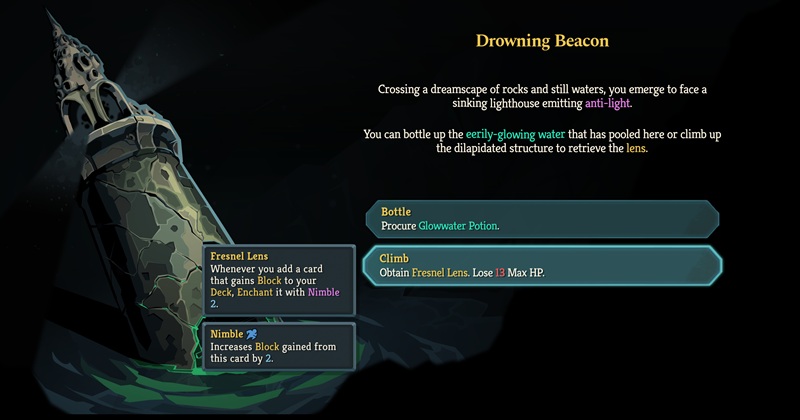
In Slay the Spire 2, an Act 1 event called “Drowning Beacon” offers a choice between two rewards:
- Procure Glowwater Potion.
- Obtain Fresnel Lens. Lose 13 Max HP.
Fresnel Lens is a relic that causes every future card that gains block to automatically gain the “Nimble” enchantment when you add it to your deck, giving that card an extra two block over the base amount.
I’m writing this post because many Slay the Spire 2 players on Reddit seem to believe the cost of choosing Fresnel Lens — losing 13 Max HP — is sufficiently negligible to make the decision a no-brainer. It’s obvious, they say, that the extra block from future card rewards will save you far more than 13 HP.
Losing Max HP, though, can represent a much bigger effective loss of HP throughout a run of Slay the Spire. Ancients heal for 80% of your missing HP at the start of Acts 2 and 3, so taking the Lens means losing out on 10 healing twice. Additionally, you can heal for 30% of your Max HP by resting at campfires. If you picked Fresnel Lens, you will heal for 4 less each time.
Also relevant are Blood Potions and several events that heal based on Max HP (I’m aware of at least three). But for simplicity, I will disregard those.
So how much effective HP can you reasonably expect to lose? At minimum, 20. Then we need to guess how many campfires you may visit afterward.
How often will you rest after the event?
Across my 70 wins in StS2, I have visited an average of 8.8 campfires — almost three per act. For Ascension 10 wins, the average goes up to 9.0. It’s possible that by the time the Drowning Beacon event appears, you will have already passed 1-2. Expecting to stop at anywhere from 5-8 more afterward is realistic.
Looking at A10 alone, I chose to rest 67 times at 149 campfires across 16 wins. In only three runs did I rest fewer than three times. Notably, wins overrepresent runs with less resting, as stronger decks are less likely to take damage.
With that in mind, a conservative guess is that you will rest at least three times after encountering the Drowning Beacon event. It’s just as likely that you might rest twice as much as that. But sticking with the conservative figure, this represents a lost opportunity to heal for 12 HP, if you chose Fresnel Lens. Factoring in the Ancients brings that up to a potential loss of 32 HP — not including any additional rests, or healing potions and events.
But hang on — doesn’t Fresnel Lens solve your block? Won’t it help you take less damage and thus require fewer rests at campfires? Won’t it help you path more aggressively and snowball the run? This is what redditors argue, and it’s wrong.
How much damage must you block to compensate?
To determine whether Fresnel Lens can help you make up for the loss of effective HP, you must ask the following question:
How much damage must you block until the extra block on the enchanted cards has compensated you for the effective HP loss?
Due to the high variance across Slay the Spire runs, it’s impossible to make exact estimations. A plausible scenario is ending the run with about half of your block-generating cards being enchanted. For example, you might have 5 Defends, 2 block cards picked up before Fresnel Lens, and 7 cards picked up after.
Let’s say the average amount of block generated by those cards is 8. Most block cards in the game don’t actually block for very much, but Fresnel Lens is bringing up the average. This would mean Fresnel Lens is responsible for 1/8th of the total block generated by the deck and that, on average, you would need to block 256 total damage before the enchantment made up 32 of it.
Even if that 50:50 ratio of enchanted:unenchanted cards isn’t accurate, it’s notable that this is only by the end of the run. On average, you will spend most of the run with fewer enchanted cards than not. Consequently, you will have blocked far more than 256 damage before Fresnel Lens contributed 32.
All of a sudden, the tradeoff is nowhere near as straightforward as redditors suggest. You can definitely expect to block some 256 damage in runs of Slay the Spire 2, though many of the game’s defensive options have nothing to do with block-generating cards. I realize this is a lot of napkin math, but the core idea remains true: That you must play many Nimble-enchanted cards before Fresnel Lens pays itself off.
More importantly, determining the value of Fresnel Lens is not about whether you’ll play the enchanted cards enough times to block some 32 damage — it’s about how long it takes to get there.
Stronger in the long-term, not short-term
Fresnel Lens does pay off eventually, but the timing of that payoff is unpredictable and slow. To use enchanted cards, you need to actually put them in your deck. That means choosing block-generating cards over other cards. You may not always want to do that, especially in Act 1, where it’s often more important to focus on damage. It’s possible that the block cards offered to you are still bad even with the enchantment. It’s possible that they don’t appear at all.
If you choose Fresnel Lens, it’s plausible to start Act 2 with a deficit of 14 HP and virtually nothing to show for it. You may have 0-2 enchanted cards in your deck. In hallway fights, it’s common to cycle through your deck only once. If you happen to draw an enchanted block card on the right turn and fully absorb damage with it, you can count yourself fortunate that you have now compensated for 2 of your 14 missing HP.
By the time you reach the first Act 2 campfire, you will most likely have less HP than if you hadn’t picked Fresnel Lens, and consequently be more likely to have to rest and thus have another 4 HP to make up. You may get around to breaking even by the end of the Act, only to then be set back another 10 HP at the start of the next one.
If you can make it that far and find good block cards along the way, then Fresnel Lens undoubtedly begins to work in your favor. But that’s if you make it that far.
Contrary to the idea that it solves your block and thus enables you to play more aggressively, Fresnel Lens sets you back on the power curve, then challenges you to compensate it for it as the run goes on. It is a relic that aims to give you long-term survivability scaling at the cost of short- and medium-term survivability scaling. It doesn’t make sense to evaluate it as though it provides the sort of short-term strength necessary to avoid resting at campfires and snowball a run.
Other considerations
Another downside of Fresnel Lens is that it automatically makes every future block card you choose ineligible for any other enchantments, including non-Skill cards that happen to have some block attached to them.
Losing Max HP also puts you at a greater risk to variance in incoming damage, especially earlier in the run when you won’t have had the time to pick up enchanted block cards to mitigate that variance.
Fresnel Lens costs you even more effective HP whenever it would cause you to overheal. It’s not uncommon to rest at the final campfire before the Act 3 boss gauntlet even if above 70% HP. For example, if you rested from 48/60 HP, you would start the fight at 60 HP — as opposed to 70 if you had rested from 48/73 HP. In this single situation, the lower Max HP is costing you 10 effective HP in the next fight. You would need to successfully block — and not over-block — with at least five enchanted cards to break even.
Additionally, this whole time I have only compared choosing Fresnel Lens to simply playing the game without it. But the actual choice is between Fresnel Lens and Glowwater Potion, a genuinely good potion that actually provides the short-term power that can help you play more aggressively.