It can be the difference between crashing and winning
Jul 15, 2026 | Clovis
In the timestamped video above, I am involved in a racing incident while leading a Formula 4 sim race at Croft Circuit. These are my thoughts about it.
My primary intent in reviewing any racing incident is to determine what I could have done differently to avoid it. After all, even if I am not at fault, it is almost always preferable to avoid the incident in the first place. Identifying the guilty party is only secondary — albeit satisfying, when it isn’t you.
So I must ask myself: Could I have avoided it? And if so, why didn’t I?
Yes, I could have avoided it
I braked for the corner known as Sunny In, and Gouranga_Man braked later than me to get alongside. I then turned in as though he hadn’t been there. If I’d just held off on turning, we could have avoided a collision. So why didn’t I?
To provide context, this was a reverse grid race that G_Man was briefly leading. By the end of the opening lap, I was already the next car behind him and rapidly catching. I was the fastest driver that day, and he was among the slowest, with a massive pace deficit to me.
After passing him on the second lap, I believed G_Man was done and dusted. I did not see him as a threat. Instead, my mind was on Andris, the only other driver who had the pace to give me trouble. I wanted to put my head down and start building a gap while Andris was still working his way to the front.
I also assumed that, knowing his race wasn’t with me, G_Man would not waste our time trying to fight a losing battle, which is something experienced racers know to avoid.
Simply put, I was too eager to focus on the race ahead, but I really should have given myself a little extra time to consider who was behind me. I didn’t check my mirrors. I’d even turned off my HUD. The collision took me completely by surprise. So that’s on me.
But I was not at fault
Gouranga_Man said I turned into him. If this is technically true, it is only because he braked deep and poked his nose into the fastest corner entry on the track. That’s not a good move.
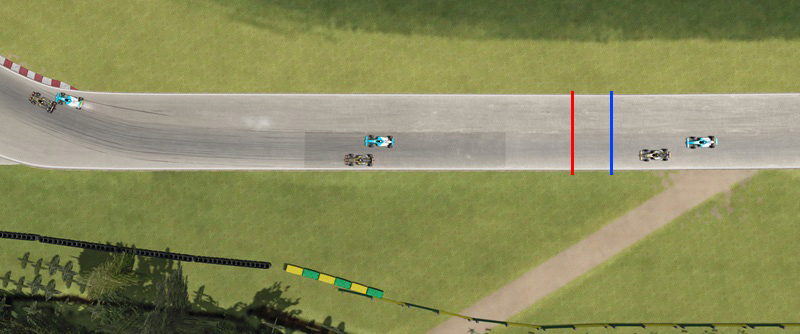
The image shows:
- When I hit the brakes
- When I began to turn in
- When the collision occurred
- Blue line: Reference braking point from my pole position lap
- Red line: G_Man’s braking point before the collision
I include the pole braking point to show that I did not brake particularly early at the time of the incident. It’s common to brake earlier during a race than during an all-out qualifying lap.
To be fair to G_Man, this was a corner many drivers handled differently. On his best quali lap, Andris braked even later than the red line, close to that darker patch of concrete. So this is not to say that nobody could brake later than me. But it’s unlikely that G_Man, whose best lap was 2.8 seconds slower than mine, was better at taking that corner.
Even if he was truly faster in the entry, that specific attempt wasn’t well executed. I braked for 1.2 seconds, roughly half of it at maximum pressure. G_Man braked for nearly 1.8 seconds and was still 15 kph faster than me at the point of contact while on a compromised line. Without the collision, he would have gone deep into the corner and may not have made it at all.
More importantly, trying to pass from that far behind at a fast corner is generally a bad decision, such that even if your execution is top shelf, it may still not be good enough. G_Man would have been better off sitting back and waiting for an opportunity at a better overtaking spot, as I did on several occasions while coming up behind slower drivers at this part of the circuit.
This is another reason I had not expected the move. Diving to get momentarily alongside another driver at a corner like Sunny In is always going to get hairy — for everyone involved. I didn’t even consider that he might go for it anyway.
Divebombing in a fast corner
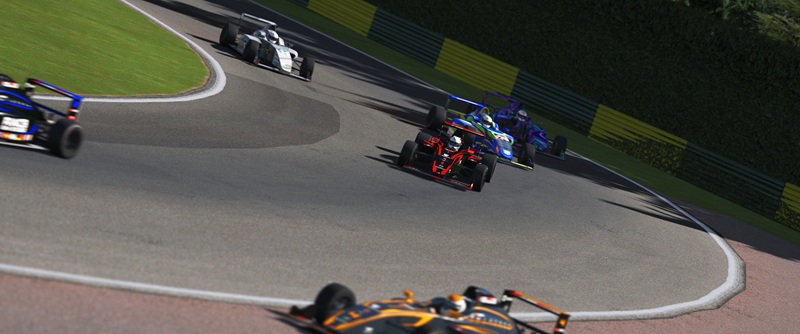
Divebombs are somewhat contentious in real racing. Their fundamental feature is to force a defending driver to take avoiding action, putting them on a suboptimal line and, the hope is, causing them to yield the position.
However, they only work when the defending driver is inclined to yield (occasionally he is not, and the attacking driver is almost always found at fault for the ensuing crash), or when the defending driver has time to yield. Consequently, divebombs are usually reserved for hard braking zones.
Divebombing into a fast corner, where the braking is brief and not particularly heavy, is only asking for trouble.
I began to turn into Sunny In almost exactly halfway through my 1.2-second braking period. Six tenths before, G_Man was still half a car length behind me. By the time I began steering, he had just the slightest overlap with my rear axle. The average human reaction time is about 2-3 tenths, so that’s technically enough time to react — but not much time. Critically, that figure is when expecting to react to something. If you do something totally unexpected and count on someone to react within half a second, you’re going to be disappointed.
So divebombs work when you can depend on defending drivers to respond to them, and that’s outright less likely to be the case in fast corners because of the speeds involved. Putting aside reaction time, fast corners are a bad place for divebombs even when the defending driver sees them coming, because he can simply brake a little deeper and carry more speed around the outside. Had I avoided G_Man, it would have been trivial to stay ahead.
As a result, experienced drivers don’t resort to divebombs in fast corners. They’re simply too likely to lead to a crash and too unlikely to produce an actual overtake. They’re a high-risk low-reward move. This actually creates a feedback loop: Because an overtake is unlikely, defending drivers are less disposed to expect a dive — so if one does occur, they are more likely to be caught off guard. This further amplifies the risk and further disincentivizes the attacking driver to go for it, in turn further leading the defending driver to disregard the possibility.
It’s just a bad idea all around.
The final lesson
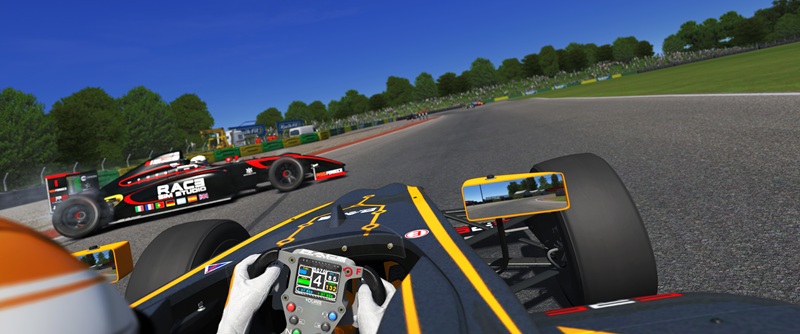
Despite all the reasons I gave for not expecting G_Man to make that move, I should still have anticipated it. I knew the standard of driving on that server was low. Andris and I were a full second clear of the next best in qualifying. There was constant spinning and crashing in both races.
Having reviewed G_Man’s onboards, I can confidently say he didn’t know how to take Sunny In corner at all, let alone with someone near him. This is not meant to disparage him, but to acknowledge that he is inexperienced, or simply lacked practice for this particular event. The point is that I shouldn’t have needed to look at his onboards after the fact to have known to be mindful of him. Knowing that he had started at the front of the reverse grid — ahead of my newbie brother, with all of his 10 hours of total simracing experience — was already one major clue to be careful, among others.
Just as on street roads, the best defense against reckless driving is caution, so one can anticipate the behavior and have more time to respond to it. But defensive driving is slow; in a racing context, it must be done selectively. I failed to identify that it was necessary at that moment and paid the price, even though I’d already seen enough that should have put me on alert.
Every racing situation is unique. There are countless variables to take into consideration, like velocity, tire wear, or the shape of an upcoming corner. Ultimately, I failed to avoid a collision because I didn’t take the time to consider the most important variable: Who am I racing?